
Home / The Story / Emblematic measles
4. Emblematic measles
Chapter 4 of 8 1917–1922
100,000 · the promise, 18 times the town, far above this chart
Bend counted 5,415 in 1920
- 1. A city of two thousand to 1912 · 16 records
- 2. The Taboo 1913 · 8 records
- 3. Wearing the promise 1914–1916 · 20 records
- 4. Emblematic measles 1917–1922 · 81 records
- 5. For the use of all 1923–1929 · 10 records
- 6. The emblem outlives the club 1930–2010 · 58 records
- 7. They got there 2011–2021 · 29 records
- 8. Carrying it forward since 2022 · 14 records
The emblem gets onto butter and lumber, the money runs out, and in 1922 the town is told it may use the mark any way it sees fit.
About 5 minutes · 81 records
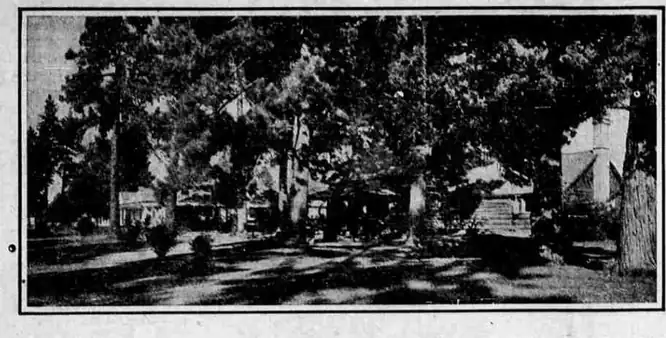
May 10, 1919
The only photograph of the house from the club's own years, printed the week the reorganized club bought it back.
The Bend Bulletin · Historic Oregon Newspapers, University of Oregon
On the table at the 1913 dinner were small printing cuts of the emblem, to be handed to the Bulletin’s editor that night so that every member could put the mark in his advertisements, on his checks and on his stationery. Cheney hoped the next issue “will not only have the Emblem at the top of the Editorial Column, but that the whole paper will look as if it had the emblematic measles.”
It took a few years, and then the paper did. In February 1917 the Bend Park Company was running a small weekly box on page 3, selling real estate and insurance from 122 Oregon Street, with the emblem in the middle of it. The firm that had bought a whole page to claim the brand was now using it the way any business uses a mark. Twelve days after the first of those boxes a grocer named L. B. Lafollette announced Bend Emblem Butter and printed the emblem twice in his own advertisement. In one month the mark was on a land company’s letterhead and on a butter wrapper.
The clubhouse, meanwhile, was where Bend organized itself. In the first months of 1917 a university club and an athletic club were formed in its rooms, and a Knights of Columbus council held its first banquet there. Then the United States went to war. Within a fortnight fifty tables of cards were raising money at the club for the Red Cross. Within a month the hall was a barracks, and the Bend Rifles drilled there Monday and Friday nights. Then, some time that year, the clubhouse closed. Nobody wrote down when.
The next thing the paper says is dated December 29, 1917: an informal dance “as a means of bringing members together in order to reorganize the Emblem club,” arranged by five men. Six weeks later four of the five were officers, and there had never been officers before. Cheney’s club had one, the Taboo. The club that met in February 1918 elected a president, two vice-presidents, a treasurer and a secretary, the way any lodge did.
The founder still came. In June 1918 the state’s bankers met in Bend, and Cheney wired from Seattle that he would be there “to take charge of the evening’s program.” Two hundred people sat down, “the songs and nonsense rhymes of the club were sung,” and the dinner was timed to end at the train.
The money ran out in the spring of 1919. The club had a closed clubhouse it did not own and a debt of five thousand three hundred dollars. On April 24, at a dinner dance at the Pilot Butte Inn, T. A. McCann of the Shevlin-Hixon Company and C. S. Hudson of the First National bank each promised to find four other men, the ten of them to take up the debt between them. A week later the club bought its own grounds and building from the Bend Company, and Cheney gave it his equity in the property, gratis, on one condition: that the club exist. The new president, H. J. Overturf, said what it would now be for, “to make the Emblem club purely social.” A week after that, statements of dues went out to everyone on the membership list. The 1913 club had charged nothing.
It was a different institution with the same name and the same house, and the house was busier than ever. Bend’s Elks lodge was founded in it in June 1919. In March 1920 the club’s women gave a leap-year party for sixty couples with the hall in blue and gold and manzanita. That August a cigarette in a wooden cuspidor burned through the floor, and the fire chief said the town “could hardly afford to lose such a historic building as the Emblem club.” In November nearly a hundred members of the new Bend Commercial Club adopted their constitution in its hall. That body became the Chamber of Commerce.
The emblem, meanwhile, had a life of its own. In May 1921 a Redmond creamery was found shipping butter into Bend with wrappers “bearing the circular Bend emblem,” and the Bulletin was precise about whose it was: “The emblem which is being used is that of the Emblem club of this city.” Within a week the distributor said it would stop. Nobody had registered anything. The town objected, and that was enough. That July an editorial recalled the club’s songs and printed four lines of one, the only lyric that survives: “Mother’s old and cannot realize, but soon we hope she will / More than half the State of Oregon’s the other side the hill.”
In April 1922 Carl Johnson interrupted a Commercial Club luncheon, where the chairman was tapping a spoon on a water glass, to present it on behalf of the Bend Iron Works with a gavel and “a juniper block with a Bend emblem on it, for use in calling the club to order.” Ten weeks later the same Commercial Club reported on the question of a Bend emblem, and the answer was in the paper on June 15.
The committee to investigate the matter of a Bend emblem reported in favor of the one adopted several years ago by the Emblem club, which has given its permission for the club to use the emblem in any way it sees fit. The report states that the Bend Iron Works is already prepared to manufacture emblems for use on automobiles, of aluminum.
In any way it sees fit. A decade after a land company had printed it over the word copyrighted, the mark belonged to Bend.
The objects of this chapter
4 of this chapter's 81 records. The strip scrolls sideways.
-
February 16, 1917
The first of three organisations constituted in these rooms inside ninety days.
-
February 14, 1919
The best description the archive holds of what an evening in the clubhouse was actually like.
-
Where the Chamber wrote its rules
November 13, 1920
The body that still runs Bend's commerce adopted its constitution in this room, with a hundred men present.
-
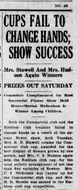
The cup stays with Mrs. Hudson
August 24, 1922
The club's prize still circulating in the last summer the club itself had.
Sources for this chapter (26) — primary unless marked
The Emblem Club — Being a Memory of the Address of the Taboo at the First Annual Dinner of the Club — January 4, 1913 · The Bend Park Company advertises with its own emblem, February 1917 · The Bend University Club organised at the Emblem club, February 1917 · "Bend Emblem Butter" — a display advertisement carrying the emblem, February 1917 · "Club privileges to the women of Bend, membership… being excluded" — March 1917 · Fifty tables of cards for the Red Cross at the Emblem club, April 1917 · "The Emblem club hall will be used temporarily for barracks", May 1917 · The Knights of Columbus organize, and adjourn to the Emblem Club for a banquet · A dance to bring the Emblem Club's members back together · "To Reopen Club" — the clubhouse had closed, January 1918 · Officers elected and thrift stamps purchased · Cheney wires that he will come from Seattle to lead the Emblem Club's programme · "Emblem Club Dinner Success" — more than two hundred at the bankers' reception, June 1918 · The Emblem Club reorganized, with its debt underwritten and a full slate elected · The Emblem Club buys its building back for $5,300 · "Statements of dues to all whose names are on the membership list", May 1919 · Bend's Elks lodge is instituted at the Emblem Club · "Blue and gold, the club colors" — the leap year party, March 1920 · "Such a historic building" — the fire chief on the Emblem Club, August 1920 · The new Bend Commercial Club adopts its constitution at the Emblem Club · "The circular Bend emblem" on butter wrappers, and the row that stopped it · "Over the Hill" — four lines of an Emblem Club song, recovered 1921 · Museum remembrance: the club, its books and the 100,000 goal (a later account) · A juniper block with a Bend emblem on it, given by the Bend Iron Works · The Bend Bulletin (daily), 15 June 1922, page 1: "Auto Emblem Endorsed" · The Bend Bulletin, 22 June 1922, page 7, columns 4-5: "Auto Emblem Endorsed"
Next
5. For the use of all
The club votes itself out of existence, and an editorial says what was left: the emblem, given to the town for the use of all.