
Home / The Story / Wearing the promise
3. Wearing the promise
Chapter 3 of 8 1914–1916
100,000 · the promise, 187 times the town, far above this chart
Bend had last counted 536 in 1910
- 1. A city of two thousand to 1912 · 16 records
- 2. The Taboo 1913 · 8 records
- 3. Wearing the promise 1914–1916 · 20 records
- 4. Emblematic measles 1917–1922 · 81 records
- 5. For the use of all 1923–1929 · 10 records
- 6. The emblem outlives the club 1930–2010 · 58 records
- 7. They got there 2011–2021 · 29 records
- 8. Carrying it forward since 2022 · 14 records
The oath, and three years of keeping it in public: a log house on the river, a governor at dinner, and the emblem set into glass.
About 3 minutes · 20 records
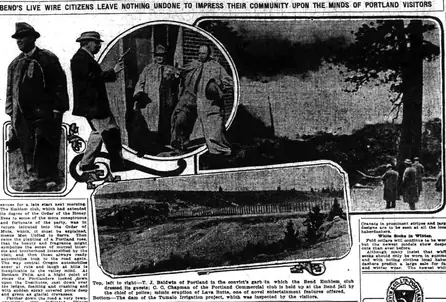
September 13, 1914
The Oregon Journal's page on the Portland visit: a guest in convict's stripes, a hold-up at the jail, a mock eruption of Lava Butte.
Historic Oregon Newspapers · University of Oregon Libraries
This is what the six men who received certificates that night, January 4, 1913, signed.
I agree to wear this emblem constantly, every day and upon every occasion, until Bend has a population of one hundred thousand. I agree so to conduct my affairs that they shall never conflict with the best interests of Bend as a whole; and I promise to work together with the wearers of this emblem to build and sustain the reputation of Bend, its honor, dignity, cheerfulness, optimism, gaiety, activity, hospitality, and solid prosperity, and in so doing to traduce no other town or community.
Cheney was explicit that the wearing was the point. If enough men wore the emblem in their lapels and answered, when asked, “I have agreed to wear it until Bend has a population of one hundred thousand,” then “such a display of faith and determination would build a city of one hundred thousand.” Taking it off was resigning. Members were given emblems for the glass of their doors and the windshields of their cars too, so that a stranger “will go along the street, passing many a door, until he finds one with an Emblem on the glass, and there he will find courtesy and honesty.”
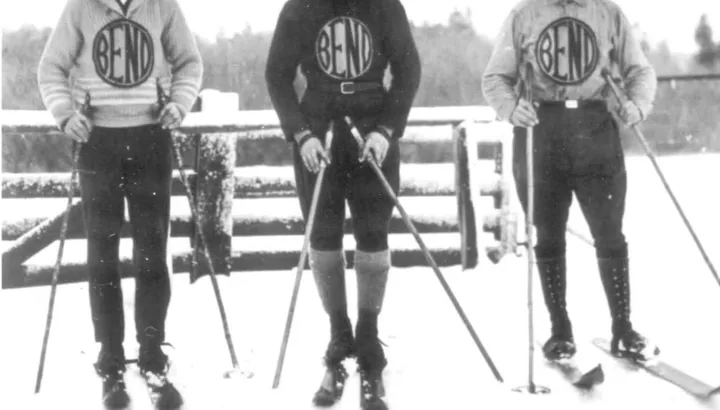
Then the club went out and performed it, for three years, in front of anyone who would come.
In February 1914 the annual dinner was held in a log house on the Deschutes that Alexander Drake, the man who platted Bend, had built when the town was a camp. The paper had announced the house’s sale to a Chicago buyer. The sale was a hoax, staged to keep the repairs quiet while the house was fitted up as a clubhouse, and the members found out at dinner. That summer an addition went up with room for two hundred diners, because in September the Portland Ad Club was coming by special train and the club meant to feed all of them.
The Portland men got what they came for. The Oregon Journal’s correspondent wrote that “the young men of Bend have set up a log temple dedicated to hospitality and good cheer. This is the Bend Emblem club and the reason for it. The old name Farewell Bend they changed in implication to Welcome Bend.” The Journal ran a page of photographs: a guest in convict’s stripes, a hold-up at the jail, a mock eruption of Lava Butte. A few weeks earlier the club had entertained a party of railroad immigration agents by having one of them arrested for fishing without a license and letting him get as far as paying the fine. In October the Portland men returned the favor with a dinner in their own city, an ebony baton for the Taboo, and two chime clocks for the clubhouse that “compelled silence at every quarter hour.”
The guests kept coming. In June 1915 the club gave a banquet for Governor Withycombe. In January 1916 the club’s women issued the first leap-year invitation Bend had seen, and the paper printed the whole card: “Dance. Leap Year. Emblem Club. January 21, 1916. Bring Him. Dance Him, Take Him Home. Are You on? 8:30 p. m. sharp.” That August the Western Pine Manufacturers arrived in three sleeping cars, and the clubhouse was “thrown open to them during their stay.”
And the emblem left the lapel. In November 1916 the Bulletin described Hugh O’Kane’s new building at Bond and Oregon streets, where the emblem “is set in the transom over each window in leaded glass,” and reported that the Shevlin-Hixon mill was stamping it on Bend pine and printing it in advertising. Four years after a land company drew it, the mark was in the architecture and on the lumber. Some of that glass is still in the building.
The objects of this chapter
4 of this chapter's 20 records. The strip scrolls sideways.
-
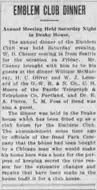
February 11, 1914
The first annual dinner held in the lodge the club had just bought behind a sale to an invented Chicago buyer.
-
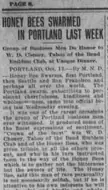
October 14, 1914
The office of Taboo made into an object, and handed over at a dinner two hundred miles from Bend.
-
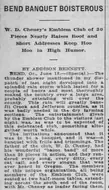
A banquet with whistles and horns
June 19, 1916
An outsider's account, written for a Portland paper: what the club sounded like to someone who had not sworn the oath.
-
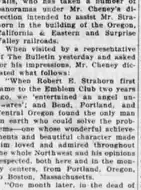
We entertained an angel unawares
November 29, 1916
Asked what the club had amounted to, the founder answers with the day the railroad walked in unrecognised.
Sources for this chapter (17) — primary unless marked
The Emblem Club — Being a Memory of the Address of the Taboo at the First Annual Dinner of the Club — January 4, 1913 · An annual dinner and the Drake house · Entertaining Great Northern immigration agents · Preparing the clubhouse addition · The Oregon daily journal (Portland), 13 September 1914, page 40: "A Community of Good Cheer" · The Bend Bulletin, 16 September 1914, page 8: the Bulletin's reprint of "A Community of Good Cheer" · The Bend Bulletin, 14 October 1914, page 8, columns 1-2: a Portland dinner in honour of W. D. Cheney · Governor Withycombe’s banquet · "Bring Him. Dance Him, Take Him Home." — Bend's first leap year dance, January 1916 · The Emblem Club is thrown open to the Western Pine Manufacturers · Emblem Is Decorative: glass, pine and advertising · The emblem reprinted beside the O’Kane building · O’Kane glass: originals and the 1985 reproductions (a later account) · Three skiers in emblem sweaters, museum-held photograph · “Bend Emblem Club”, Deschutes Historical Museum, 2013 (this project's reading) · "What of its future?" — the clubhouse photographed for sale, April 1955 · The Drake lodge is razed, and little of it can be salvaged
Next
4. Emblematic measles
The emblem gets onto butter and lumber, the money runs out, and in 1922 the town is told it may use the mark any way it sees fit.