Home / Archive / June 19, 1916
A banquet with whistles and horns
The Oregonian · June 19, 1916
In the story: 3. Wearing the promise, 1914–1916.
Drag to pan. Scroll, pinch, or press + and − to zoom. Esc closes.
A band of whistles, horns and trumpets; a hundred numbers; and a railway agent who turned the clock back two hours so the Emblem Club could finish.
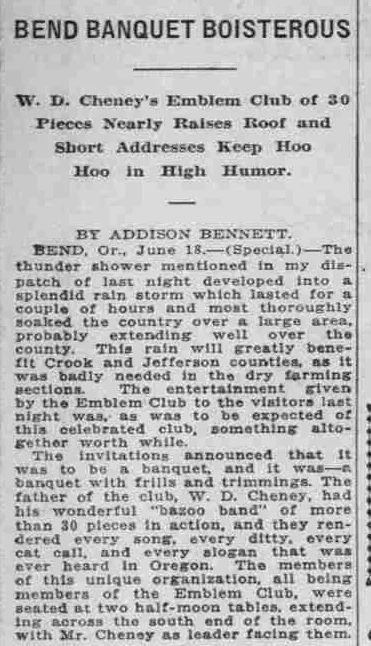
In June 1916 the Concatenated Order of Hoo-Hoo, the lumbermen’s fraternity, came to Bend, and the Emblem Club fed them. The Oregonian sent Addison Bennett, who filed a column under the head “BEND BANQUET BOISTEROUS” and gave the club the best notice it ever had from outside the county.
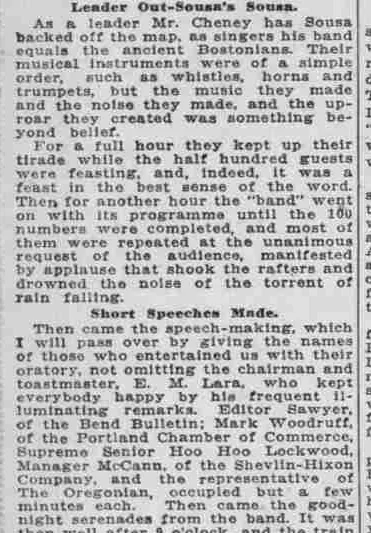
The band is the thing. More than thirty pieces, “of a simple order, such as whistles, horns and trumpets, but the music they made and the noise they made, and the uproar they created was something beyond belief.” The members sat at two half-moon tables across the south end of the room with Cheney facing them, and Bennett’s verdict on him is a sentence worth keeping whole: “As a leader Mr. Cheney has Sousa backed off the map, as singers his band equals the ancient Bostonians.”
They played for an hour while fifty guests ate, and then for a second hour “until the 100 numbers were completed, and most of them were repeated at the unanimous request of the audience, manifested by applause that shook the rafters and drowned the noise of the torrent of rain falling.” The rain is not decoration; Bennett’s dispatch opens with it, a two-hour storm that would “greatly benefit Crook and Jefferson counties, as it was badly needed in the dry farming sections”.
The speaking was kept short, and the list of who did it is the town in one paragraph: E. M. Lara in the chair as toastmaster; Editor Sawyer of the Bend Bulletin; Mark Woodruff of the Portland Chamber of Commerce; Supreme Senior Hoo Hoo Lockwood; Manager McCann of the Shevlin-Hixon Company; and the representative of The Oregonian, whom Bennett lists last and does not name. Lara had been one of the sixteen who went to Portland with the club in 1913. The Shevlin-Hixon manager is given as McCann with no initials. He is T. A. McCann: the Bulletin names him in full in July 1921, vice president of the company, at the farewell dinner forty members of the club gave him — eleven months after he had deeded them the clubhouse for a dollar.
The last detail is the best one. The Hoo-Hoo train home on the Oregon Trunk was booked to leave at eight; the good-night serenades were still going well after nine. “However, the North Bank agent turned back the clock a couple of hours and all got away about 10 P. M.”
Bennett calls the club “this celebrated club” and “the father of the club, W. D. Cheney” — an outsider’s attribution, in 1916, from a paper with no stake in Bend’s self-description.
From the source
BEND BANQUET BOISTEROUS
W. D. Cheney’s Emblem Club of 30 Pieces Nearly Raises Roof and Short Addresses Keep Hoo Hoo in High Humor.
BY ADDISON BENNETT.
The entertainment given by the Emblem Club to the visitors last night was, as was to be expected of this celebrated club, something altogether worth while.
The invitations announced that it was to be a banquet, and it was — a banquet with frills and trimmings. The father of the club, W. D. Cheney, had his wonderful “bazoo band” of more than 30 pieces in action, and they rendered every song, every ditty, every cat call, and every slogan that was ever heard in Oregon.