
Home / The Story / For the use of all
5. For the use of all
Chapter 5 of 8 1923–1929
100,000 · the promise, 18 times the town, far above this chart
Bend had last counted 5,415 in 1920
- 1. A city of two thousand to 1912 · 16 records
- 2. The Taboo 1913 · 8 records
- 3. Wearing the promise 1914–1916 · 20 records
- 4. Emblematic measles 1917–1922 · 81 records
- 5. For the use of all 1923–1929 · 10 records
- 6. The emblem outlives the club 1930–2010 · 58 records
- 7. They got there 2011–2021 · 29 records
- 8. Carrying it forward since 2022 · 14 records
The club votes itself out of existence, and an editorial says what was left: the emblem, given to the town for the use of all.
About 3 minutes · 10 records
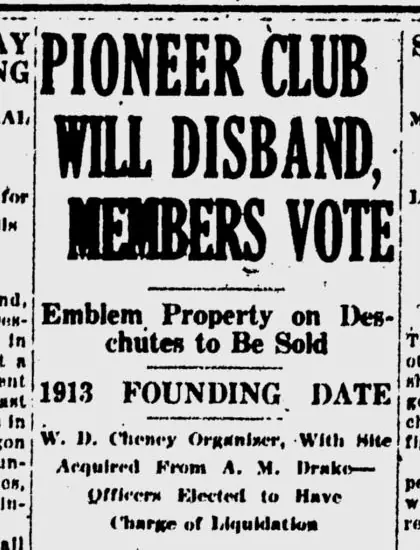
May 13, 1924
The front page the day after the vote: seven directors to sell the house, a membership “limited to 50”, and a founding date the paper's own files contradict.
The Bend Bulletin · Google News Archive
On the night of Monday, May 12, 1924, at the club’s annual meeting, its stockholders voted to disband. The Bulletin put it on the front page the next afternoon: “Pioneer Club Will Disband, Members Vote.” The club had been inactive for a year, its activities “mostly social in nature, the membership being limited to 50.” Seven directors were elected to sell the property, “a log building with a ballroom overlooking the river.” Two of the seven, George A. Jones and J. C. Rhodes, had been in the parlor car to Portland in 1913. The men who had gone down to sing were the men who wound it up.
Ten days later the paper ran an editorial, the nearest thing the club has to an obituary written by someone who was there. It separated two clubs. The first was Cheney’s: the publicity trips, the songs, the stunts, the Portland visit of 1914. When the war came and Cheney’s own finances turned, the writer said, he had to withdraw his support, and the members carried on as a quieter private social club. That was the club now voting itself out of existence. Then the editorial turned to what was left.
There remains only the club device, the Bend emblem, at first copyrighted by Mr. Cheney and then given to the town for the use of all. That is likely to endure as long as there is a town here.
That sentence is the reason this website exists, and it was written in 1924.
Cheney was not in the room. He had left the Bend Park Company about 1919, the year he gave the club his equity in the house, and gone to Oklahoma to take up his original profession, petroleum geology. He organized an oil company there in 1930 and died at his home near Okmulgee in January 1943. The Bulletin’s obituary called him Bill, remembered the special trains he had run to Bend from Seattle, Portland and Spokane, and named his wife as the former Mrs. A. C. Rhodes, mother of J. Clark Rhodes. One of the seven men who wound up his club was his stepson.
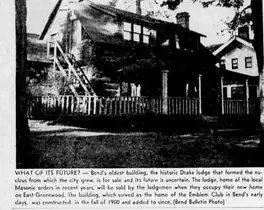
The house went to the Masons in July 1924. The cup went on: the silver cup the club had put up at the flower show in 1912 was awarded again three months after the vote, and would be for another twenty-three years.
The emblem went on too. In June 1925 the Shevlin-Hixon Lumberjack Band carried wooden souvenirs bearing it to Portland. That September the Bulletin put it on the front of a section of its county fair edition, with the letters cut out of a photograph of timbered country so that BEND reads as forest. In 1927 the Bulletin’s own print shop put the mark on the back cover of a program for the Western Pine Manufacturers. The mark was on lumber, on souvenirs and on a trade program because the same few dozen men were in every room, and none of them owned it.
Forty-five years later J. Clark Rhodes wrote a letter about the dinner of January 4, 1913. When Oregon went dry on New Year’s Day 1915 he had moved the club’s stock of liquor to his own home and salvaged a case of 1904 champagne. In 1969 he took one bottle to Hood River to see Jim Overturf, who had been the reorganized club’s president. The two of them were the last survivors of the original group, and they decided it would be more fitting to drink it together while they could “than to leave it for someone else or to wait for a sad and dismal ‘last man’ observance.” They drew the cork with a little ceremony and drank to “those who are no longer with us.” It had lost its fizz. Rhodes doubted it had caused “the tear that I think each of us furtively hid from the other.”
The objects of this chapter
4 of this chapter's 10 records. The strip scrolls sideways.
-
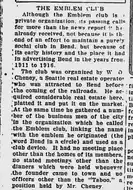
May 23, 1924
Ten days after the vote to disband, the paper wrote the sentence this site is built on.
-
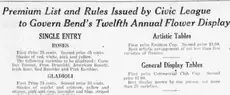
July 11, 1925
A year after the club ended, its cup is a line item in a printed prize list — which is how a name survives.
-
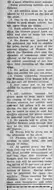
August 20, 1927
Twelve numbered rules, and the club's own condition still printed among them three years on.
-
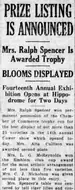
August 22, 1927
The name still doing work in the paper every August, with nobody left to maintain it.
Sources for this chapter (12) — primary unless marked
The Bend Bulletin, 1924-05-13, page 1: The club votes to disband · The Bend Bulletin, 1924-05-23, page 4: What the club left to Bend · The emblem on the Bulletin’s Deschutes County Fair edition, September 1925 · Sixteen Emblem Club members named on a trip to Portland · A retrospective dates the Masons’ purchase to July 1924 (a later account) · William D. Cheney’s obituary and the club’s remembered beginnings · The emblem travels with the Lumberjack Band · A Bend emblem on the lumbermen’s program · The Bend Bulletin, 21 August 1912, page 1, column 5: the Emblem Club's cup at the flower show · A member remembers: J. Clark Rhodes’s 1969 letter (a later account) · Allen house nomination: the May 1924 dissolution citations (a later account) · The cup awarded three months after the end
Next
6. The emblem outlives the club
A silver cup, a log house, a pane of glass and a newspaper banner carry the mark through eighty years when almost nobody photographed it.