
Home / Archive / February 12, 1943
Remembering Bill Cheney
The Bend Bulletin · February 12, 1943
In the story: 6. The emblem outlives the club, 1930–2010.
Drag to pan. Scroll, pinch, or press + and − to zoom. Esc closes.
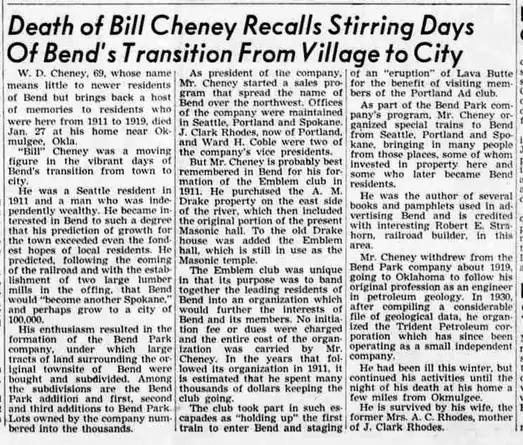
The obituary that says where the hundred thousand came from: Cheney predicted Bend would become another Spokane.
W. D. Cheney died on 27 January 1943 at his home near Okmulgee, Oklahoma, aged 69, and the Bulletin gave him most of a column under a headline that begins “Death of Bill Cheney”. The obituary opens by admitting that his name “means little to newer residents of Bend”.
One sentence in it answers a question this site has kept open. Where a town of about a thousand people got the figure of a hundred thousand is not explained in the 1913 book and no contemporary source here explains it either. The Bulletin does, thirty years late and at second hand: Cheney predicted, “following the coming of the railroad and with the establishment of two large lumber mills in the offing”, that Bend would “become another Spokane,” and perhaps grow to a city of 100,000. That is the comparison the Deschutes Historical Museum reached independently in 2020, in a newspaper this archive has held since the week this site was built.
A second sentence is the club’s whole economics. No initiation fee, no dues, and “the entire cost of the organization was carried by Mr. Cheney” — many thousands of dollars over the years the club ran. A club with no subscription is a club that ends when one man stops paying, and he withdrew from the Bend Park Company about 1919.
The obituary also settles the building. Cheney bought the A. M. Drake property on the east side of the river, “which then included the original portion of the present Masonic hall. To the old Drake house was added the Emblem hall, which is still in use as the Masonic temple.” So the clubhouse was an addition to Drake’s house, and in 1943 it was still standing.
The rest is the man. Offices in Seattle, Portland and Spokane; J. Clark Rhodes and Ward H. Coble as vice presidents of the Bend Park Company; special trains run from all three cities; books and pamphlets advertising Bend; credit for interesting the railroad builder Robert E. Strahorn in the region; and, as escapades, the club “holding up” the first train into Bend and staging an eruption of Lava Butte for the Portland Ad Club. He left for Oklahoma about 1919 to return to petroleum geology, organised the Trident Petroleum corporation in 1930, and was survived by his wife, the former Mrs. A. C. Rhodes — J. Clark Rhodes’s mother.
The column dates the club to 1911. Contemporary notices establish it in 1912, and the precise beginning is still unsettled; a 1943 obituary is a memory, not a record.
From the source
Death of Bill Cheney Recalls Stirring Days Of Bend’s Transition From Village to City
He predicted, following the coming of the railroad and with the establishment of two large lumber mills in the offing, that Bend would “become another Spokane,” and perhaps grow to a city of 100,000.
The Emblem club was unique in that its purpose was to band together the leading residents of Bend into an organization which would further the interests of Bend and its members. No initiation fee or dues were charged and the entire cost of the organization was carried by Mr. Cheney. In the years that followed its organization in 1911, it is estimated that he spent many thousands of dollars keeping the club going.