Books, songs and a banquet
The Homesteader · June 2020
In the story: 7. They got there, 2011–2021.
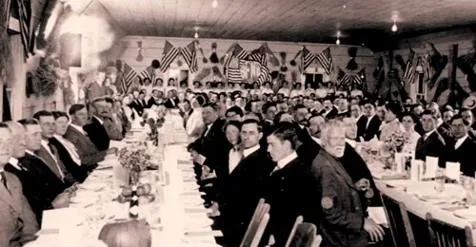
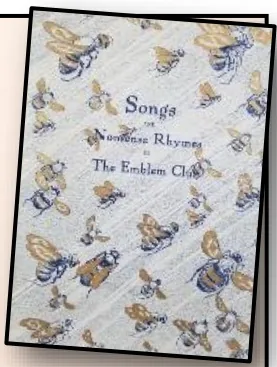
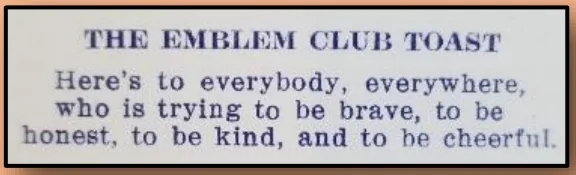
The museum’s June 2020 newsletter brings together a club book, a banquet photograph, a song booklet and the printed toast.
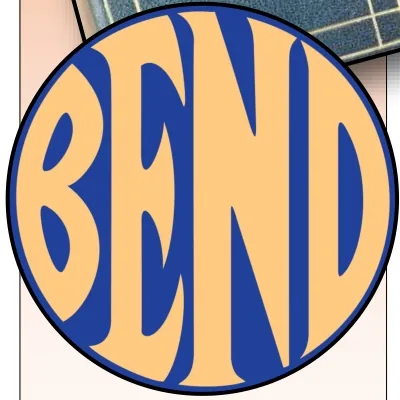
The museum’s June 2020 newsletter runs a two-page account of the Emblem Club, and its cover carries a blue-and-gold emblem with broad letters. That graphic documents the museum’s use of this treatment in 2020; its designer and earlier history are not identified.
The pictured objects offer a glimpse of the club’s printed world — the songbook, the banquet, the club toast reproduced in period type. A complete original scan of the 1913 book is still missing from this online collection.
The prose is worth more than the pictures, because it answers a question the record leaves open: where a town of about a thousand people got the number one hundred thousand. The museum’s answer is Spokane. It is a 2020 account and not a contemporary one, and it names its evidence as newspaper accounts between 1915 and 1919 — which this project has not read, and which are now a lead rather than a citation.
Two things in it are this project’s to check rather than to repeat. The date, 1937, is a calculation attributed to the club with no source given for the arithmetic. And the closing congratulation — “107 years later, for a dream realized” — picks one of the three instruments that count Bend, without saying which. By the decennial census the promise was not complete in 2020, and is not complete now.
Where it sits, and who put it there. The drawing is filed with the 1912 cut, placed there by the curator on 16 September 2026 as a perfect trace of the original. The character matrix reads it in the 1917 rounding instead, and the character it turns on is the one that separates those two families: at 676 pixels of letter this drawing's strokes turn in a curve where the July 1912 advertisement's come to a point. Its last letter does still taper, which is what keeps it out of the museum rounding. Both readings are the record; the families handbook carries them and says what would settle it.
From the source
The population of Bend in 1910 was only 536. With the arrival of the railroad in 1911, the population had crept to just over 1,000 by the time the Emblem Club set their target of 100,000. What a lofty goal! Just where did that goal come from? What gave them such confidence?
Newspaper accounts between 1915 and 1919 reveal the answer lay in Spokane, Washington and railroad tycoon James Hill. When the Great Northern Railway arrived in Spokane in 1892, the city’s population spiked as the economy formed around a railroad hub serving the farmers of Eastern Washington. In 18 short years, the population of Spokane grew from just over 19,000 to 104,000 by 1910. When Hill’s Great Northern Railway won the Deschutes River Railroad War and steamed into Central Oregon in the fall of 1911, the promise of such a boon seemed all but assured for Bend as well. By their calculations, Emblem Club members believed they would reach 100,000 by 1937.
Measured
The 1912 cut, the angular construction. Broad letters, a three-armed E, a capital N, and corners that taper to a point.
Read at high confidence from 676 px of letter, which is an upper bound: this drawing's letters run into its ring, and no cut separates them.
Each drawing is reduced to the same thing — the letters BEND, cropped to their own ink, rasterised at a common size — so two of them can be compared by shape alone.
- Device aspect
- 0.999 The roundel’s width divided by its height. 1.000 is a true circle; anything else is an oval, or a photograph taken at an angle. 0.977 – 1.048 across the collection
- Word aspect
- 0.997 The same ratio for the block of BEND letters alone, once cropped to their own ink. 0.927 – 1.862; the high end is lettering set wide rather than stacked
- Figure ink
- 0.669 How much of the drawing is ink rather than ground. A heavy ring and fat letters push it up. 0.169 – 0.728, median 0.493
- Coverage
- 0.523 How much of the normalised square the letters fill once every drawing is reduced to the same size. 0.198 – 0.576, median 0.456
What it most resembles. Two digitisations of a single printing score 0.975, so that is what “the same artwork” looks like as a number.
- Bulletin business directory, February 1939 0.700 — related letterforms, clearly redrawn
- Bend Park Company, July 1912 0.698 — related letterforms, clearly redrawn
- The same 1912 advertisement, from the page render 0.692 — related letterforms, clearly redrawn
Least like it: Bulletin business directory, August 1949, at 0.168.
Resemblance is not descent. A high score means two drawings have the same shape. It does not establish which came first, or that either was copied from the other.
Compare this drawing with another · The board · How the drawings were measured