Home / Archive / February 1, 1939
Who’s Who in Bend, 1939
The Bend Bulletin · February 1, 1939
In the story: 6. The emblem outlives the club, 1930–2010.
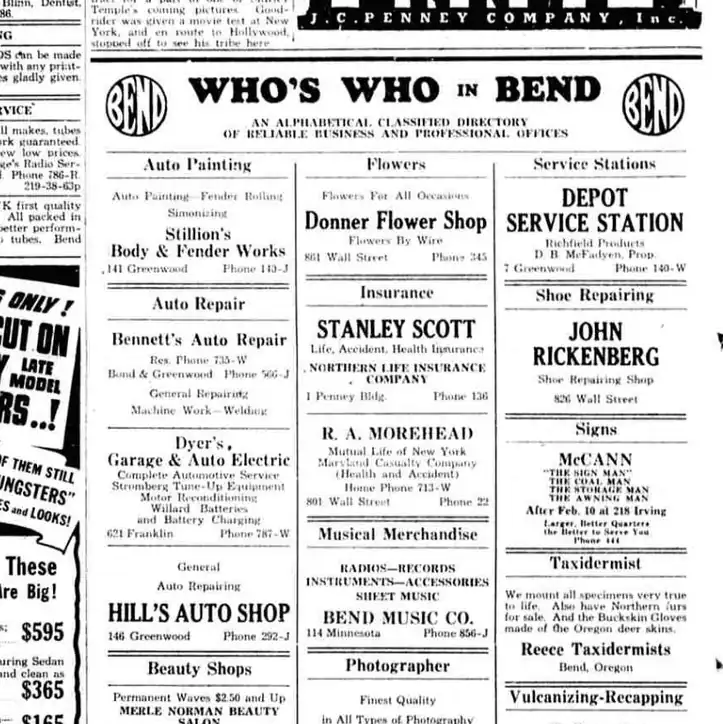
The emblem at both ends of a business directory’s banner, on the day that directory began — and on it for the next twelve years.
On Wednesday 1 February 1939 the Bend Bulletin started a new feature on page 6, and set its banner in three sizes across two lines. Beneath it, three columns of headings: Auto Painting, Auto Repair, Beauty Shops, Flowers, Insurance, Musical Merchandise, Photographer, Service Stations, Shoe Repairing, Signs, Taxidermist, Vulcanizing-Recapping — each with one or two businesses under it, their addresses and their telephone numbers.
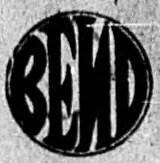
At each end of the banner, about half an inch across, is the emblem. The word BEND reversed out of a solid disc in white — condensed interlocking capitals filling the circle edge to edge, a capital N with its diagonal, the B’s two bowls meeting in a notch, the E built with three arms.
This archive has long described the years between the emblem’s last dated drawing and its next as its largest gap: March 1917, after a butter advertisement, to August 2001, when a Chamber of Commerce roundel was captured on a website. The Chamber’s own full page of June 1953 put one dated drawing in the middle of it, and the same sweep that found this directory has since put the emblem on a lumber advertisement in June 1917 and on the 1925 county fair edition. What this adds is not another point but a run: the same device heads the same directory in every year sampled, from 1939 to 29 May 1951, which is the last issue the feature ran in.
It was found by machine and confirmed by eye, in that order. A detector swept the paper’s outsized issues for round devices and proposed two on page 10 of 16 August 1950. Opening that page showed a recurring feature with a headline — and a headline is the one thing OCR can read here, since it can never see the drawing beside it. Searching 82,187 pages of already-harvested page text for that banner returned about 1,700 hits and, with them, the page number for every date.
Twenty-four of those dates have now been opened, spread across 12 years from 1939 to 1951, and the device is on every one — including the war years, when the paper ran thin and the directory kept its place. Each date is listed with its address in the sweep memo, because “the device is on every one” is a claim about pages somebody read and the addresses are what make it checkable. That is also the honest size of it: a sample of a ledger, not a count of every issue, and not a random sample either, because the issues opened were the ones that ran long. The three issues immediately before 1 February 1939 were swept and carry nothing, which makes that date a floor for the feature rather than a proof about the emblem.
The other end of the run is now measured rather than left at “the latest page anyone has looked at”. The feature’s headline and its two-line strapline are separate signatures of the same banner, and OCR can read both even though it can never see the drawing between them. Across 1930 to 1963, with every enumerated page of the harvest examined and none uncached, the two together give 1,535 issues from 6 February 1939 to 29 May 1951 and nothing after — and June, July and August of 1951 are fully cached, so the feature stopped rather than the harvest. That last issue has been opened: page 4, both devices at the ends of the banner, and the third letter running backwards in each, which is the 1950 block still in use.
1,535 is a floor and not a census. Measured against the twenty-four dates a person has confirmed by eye, the headline search alone recovers nineteen. It misses this archive’s own filed plates of 1 February 1939 and 16 August 1950, because a display face is exactly what optical text is worst at — and it misses 29 May 1951, the last issue of all, which only the strapline reaches. That last miss is why the run was bounded with two signatures rather than one. So the feature ran at least that often, and it began before either signature’s first hit.
What the run does not say is worth stating too. A newspaper printing a civic device on its own business directory is a newspaper using a mark, not a record of who cut it, who owned it, or what anyone thought it meant. Measured in research against the 1912 advertisement the 1939 impression scores 0.887 and holds within 0.009 however the device is cut — its closest match on file, tighter than anything else in the gap, and closer than the Chamber’s 1953 drawing manages. It is deliberately not entered in the measured collection: admitting it would pull the museum’s 2020 drawing into a published cluster on a pair the sweep cannot confirm, and what this site groups together is not a thing to settle in passing. The number is recorded; the grouping waits.
From the source
WHO’S WHO in BEND
AN ALPHABETICAL CLASSIFIED DIRECTORY OF RELIABLE BUSINESS AND PROFESSIONAL OFFICES
Measured
The 1917 rounding, the rounded construction. The 1912 cut's broad letters and three-armed E with corners that turn in a curve, and the last letter still tapering to a point.
Read at medium confidence from 139 px of letter, which is the letters alone, at this drawing's own letter cut.
Each drawing is reduced to the same thing — the letters BEND, cropped to their own ink, rasterised at a common size — so two of them can be compared by shape alone.
- Device aspect
- 0.987 The roundel’s width divided by its height. 1.000 is a true circle; anything else is an oval, or a photograph taken at an angle. 0.977 – 1.048 across the collection
- Word aspect
- 0.995 The same ratio for the block of BEND letters alone, once cropped to their own ink. 0.927 – 1.862; the high end is lettering set wide rather than stacked
- Figure ink
- 0.620 How much of the drawing is ink rather than ground. A heavy ring and fat letters push it up. 0.169 – 0.728, median 0.493
- Coverage
- 0.516 How much of the normalised square the letters fill once every drawing is reduced to the same size. 0.198 – 0.576, median 0.456
What it most resembles. Two digitisations of a single printing score 0.975, so that is what “the same artwork” looks like as a number.
- Bend Park Company, July 1912 0.887 — a family resemblance, not the same cut
- The same 1912 advertisement, from the page render 0.880 — a family resemblance, not the same cut
- The Bend Bulletin, November 1916 0.861 — a family resemblance, not the same cut
Least like it: Bulletin business directory, August 1949, at 0.142.
Resemblance is not descent. A high score means two drawings have the same shape. It does not establish which came first, or that either was copied from the other.
Ties touching this drawing, each in the class of evidence it has:
- Measured 0.88, steady at every cut. The 1939 directory masthead scores 0.8825 to 0.8916 against the July 1912 advertisement across every device cut — a spread of 0.009, the tightest any pair inside the 1917 to 2001 gap has held. The same-artwork band here is the 0.975 control and the 0.930 the 1916 reprint reaches, so this is the construction and not the block: a drawing of the same letters, not an impression of the same cut.
Compare this drawing with another · The board · How the drawings were measured