Home / Archive / June 16, 1953
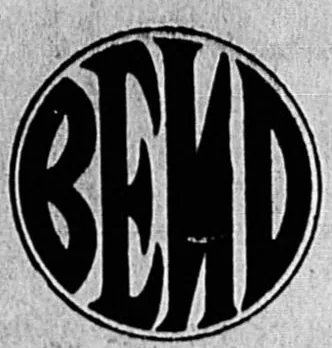
The Chamber's own emblem, 1953
The Bend Bulletin · June 16, 1953
In the story: 6. The emblem outlives the club, 1930–2010.
Drag to pan. Scroll, pinch, or press + and − to zoom. Esc closes.
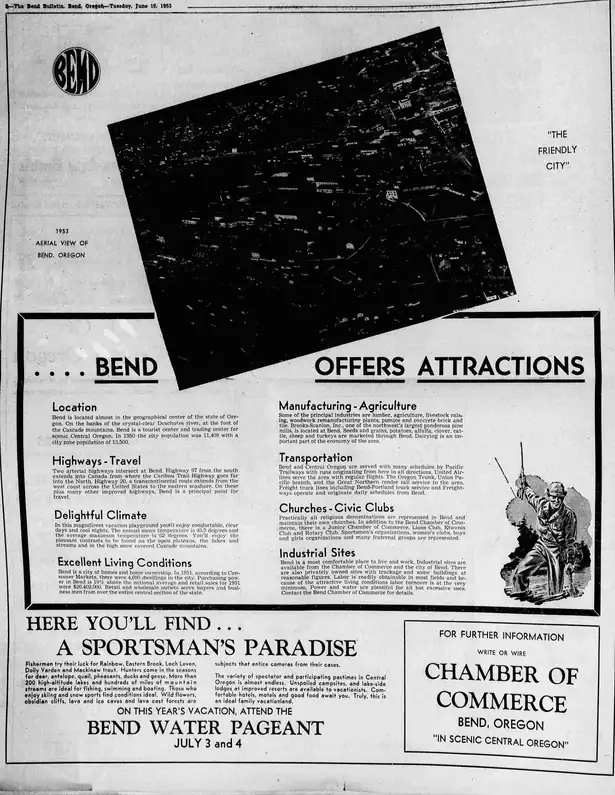
The device the project could not find between 1917 and 2001, printed an inch across at the top of a full page, by the Chamber of Commerce.
A full page in the Bend Bulletin's Golden Jubilee edition, bought by the Bend Chamber of Commerce: a 1953 aerial view of the town, “THE FRIENDLY CITY” set at the right, eight headed paragraphs on Location, Highways, Climate, Living Conditions, Manufacturing, Transportation, Churches and Civic Clubs and Industrial Sites, an invitation to the Bend Water Pageant of July 3 and 4, and at the foot “FOR FURTHER INFORMATION WRITE OR WIRE — CHAMBER OF COMMERCE, BEND, OREGON”.
And in the top left corner, an inch across, the emblem. A solid disc with the word BEND reversed out of it in white — condensed, interlocking capitals, the letters conjoined and compressed so they fill the circle edge to edge, the outer strokes of the B and the D running into the ring.
The Chamber signs the page at the foot of it, in a ruled box beside an invitation to the Bend Water Pageant of 3 and 4 July. The strapline in that box — “IN SCENIC CENTRAL OREGON” — is the same phrase the Bulletin ran across the fair edition of 1925, under a picture band with the emblem in the middle of it. Twenty-eight years apart, the town is using one line and one device together; that is a habit rather than a link, and it is worth noticing without being turned into one.
This archive has described the years between the emblem’s last dated drawing and its next as its largest gap. That gap ran from March 1917, after a butter advertisement printed the device twice, to August 2001, when a Chamber of Commerce roundel was captured on a website — eighty-four years and five months with no dated drawing at all. This page was the first drawing found inside it, and it is no longer alone. A sweep of the Bulletin’s outsized issues has since put the emblem on a lumber advertisement in June 1917, two and a half inches wide on the 1925 county fair edition, and at the head of the paper’s own business directory from 1939 to 1951. What is left unevidenced is June 1917 to September 1925, and January 1951 to August 2001.
The body that printed it is the point. The 2001 file that had been the gap's modern edge is the Bend Chamber of Commerce's Visitor and Convention Bureau logo. This is the Bend Chamber of Commerce, forty-eight years earlier, using a device of the same construction on its own full-page advertisement. Whatever the 2001 roundel was, it was not a modern invention arriving out of nowhere: the Chamber had been printing a circular BEND letter device since at least 1953, and the town’s own newspaper had been printing one since 1925.
It was found by looking. The Golden Jubilee edition's OCR had already been read in full and returned only false positives, because OCR finds the word and can never find the drawing. Sixty-six pages were pulled as images and tiled into six contact sheets, and the device is on one of them. Across the whole edition — nine sections, sixty-six pages, hundreds of advertisements by Bend businesses in the town's fiftieth-anniversary issue — it appears exactly once.
One more thing sits on the page without comment. The Chamber gives Bend's 1950 population as 11,409, with a city zone of 13,500. The Emblem Club's members swore in 1913 to keep at it until Bend had a hundred thousand. In 1953 they were a ninth of the way there, and the town passed the figure in 2021.
From the source
FOR FURTHER INFORMATION WRITE OR WIRE
CHAMBER OF COMMERCE
BEND, OREGON
“IN SCENIC CENTRAL OREGON”
Measured
The 1950 re-cut, the angular construction. The 1912 cut's broad letters and three-armed E with the third letter mirrored: its diagonal runs from the top right down to the left.
Read at high confidence from 315 px of letter, which is an upper bound: this drawing's letters run into its ring, and no cut separates them.
Each drawing is reduced to the same thing — the letters BEND, cropped to their own ink, rasterised at a common size — so two of them can be compared by shape alone.
- Device aspect
- 0.991 The roundel’s width divided by its height. 1.000 is a true circle; anything else is an oval, or a photograph taken at an angle. 0.977 – 1.048 across the collection
- Word aspect
- 0.992 The same ratio for the block of BEND letters alone, once cropped to their own ink. 0.927 – 1.862; the high end is lettering set wide rather than stacked
- Figure ink
- 0.714 How much of the drawing is ink rather than ground. A heavy ring and fat letters push it up. 0.169 – 0.728, median 0.493
- Coverage
- 0.562 How much of the normalised square the letters fill once every drawing is reduced to the same size. 0.198 – 0.576, median 0.456
What it most resembles. Two digitisations of a single printing score 0.975, so that is what “the same artwork” looks like as a number.
- BendEmblem.com 1912 adaptation 0.747 — related letterforms, clearly redrawn
- The same 1912 advertisement, from the page render 0.694 — related letterforms, clearly redrawn
- BendEmblem.com 1912 reference 0.690 — related letterforms, clearly redrawn
Least like it: Bulletin business directory, August 1949, at 0.174.
Resemblance is not descent. A high score means two drawings have the same shape. It does not establish which came first, or that either was copied from the other.
Ties touching this drawing, each in the class of evidence it has:
- A question Redrawn for the Chamber?. The Chamber’s 1953 emblem scores about 0.69 against both period impressions at every cut: the same family, far below the 0.975 control, so a redrawing rather than the same block. Whether whoever drew it had an impression in front of them is unknown. What would settle it: Part of this has now been run: the Bulletin’s outsized editions were swept for round devices and the paper’s own 1939 directory masthead came out of it, which is a surviving impression in the gap and measures far closer to 1912 than the Chamber’s drawing does. What remains is the sweep’s unopened middle — about 170 outsized issues between 1917 and 1952 are still unswept, and the directory’s own run is sampled at nine dates out of roughly 1,700 — and, for this edge specifically, anything that puts a drawing in the Chamber’s hands rather than the newspaper’s.
Compare this drawing with another · The board · How the drawings were measured