
Home / The Story / Carrying it forward
8. Carrying it forward
Chapter 8 of 8 since 2022
100,000 · the promise
Bend had last counted 99,178 in 2020
- 1. A city of two thousand to 1912 · 16 records
- 2. The Taboo 1913 · 8 records
- 3. Wearing the promise 1914–1916 · 20 records
- 4. Emblematic measles 1917–1922 · 81 records
- 5. For the use of all 1923–1929 · 10 records
- 6. The emblem outlives the club 1930–2010 · 58 records
- 7. They got there 2011–2021 · 29 records
- 8. Carrying it forward since 2022 · 14 records
The club is gone. The emblem is on flags, signs and windows, and here are the files.
About 1 minute · 14 records
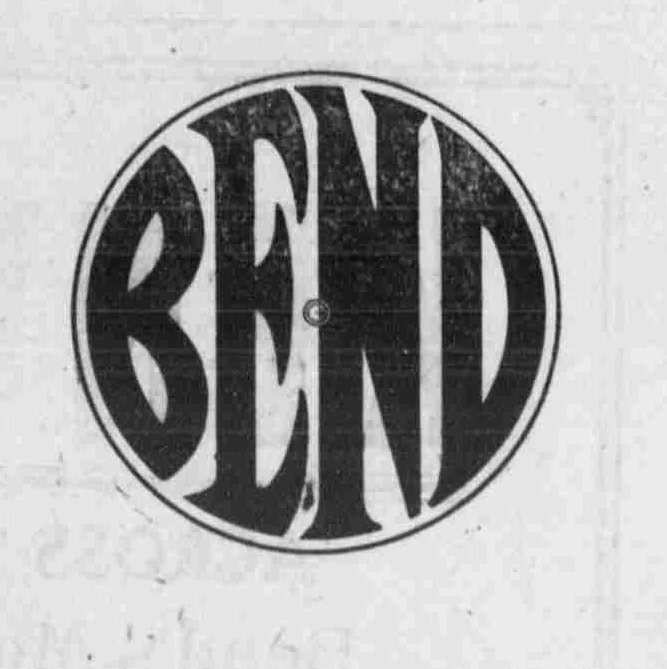

The drawing this site gives away, beside the impression it was traced from, at the same size. The resemblance is measured; the number is on the emblems page.
1912 impression: Historic Oregon Newspapers, University of Oregon Libraries. The adaptation: this project.
The emblem never needed the club. It was drawn before the club swore by it and given away before the club ended. Since then it has been on a butter wrapper, a juniper block, a mill’s lumber, a transom window, a chamber of commerce page, a license plate and a museum’s shirts. In 2022 the town’s tourism bureau closed a presentation with it. In 2023 the city designed its neighborhood flags around it. In 2026 it is cut in relief on the sign at the gate of the city’s water plant. A century on, it is exactly what a 1924 editorial said it would be: the one thing that remained, “given to the town for the use of all.”
One of the people who carried it knew the story. In 2014 a Bend artist, Vicki Roadman, described a work called Seize the Day in which the emblem rises as a sun above mountains and water, “in honor of William Cheney who designed it in the early 1900s.” The attribution is hers; nothing on file says who drew it. The work hangs on the O’Kane Building, under transoms that have carried the emblem in leaded glass since 1916.
What comes back is the Emblem, not the club. The club was a thing of its time, with its secrecy, its cape and gold ribbon, its forty chairs and its Taboo. Nobody is asked to join anything, and nobody needs permission to use the emblem.
What carries forward is the founder’s simplest instruction. He put printing cuts on the table so the mark would spread through newspapers, checks and stationery, and handed out emblems for doors and windshields so it would be in the glass and on the road. The files do the same job. Use it. Share it. Put it somewhere. This is the printing block.
The objects of this chapter
4 of this chapter's 14 records. The strip scrolls sideways.
-

The emblem at the water plant gate
July 15, 2026
Cut in relief on the entrance sign of the city's filtration plant: one of only two physical objects the City owns that this archive can show carrying the mark.
-

June 15, 2022
The town's tourism bureau closing a presentation on the emblem, in the club's own blue and gold.
-
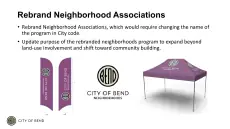
May 9, 2023
The City designing neighborhood flags around it, a century on, with nobody's permission needed.
-

Photographs that introduced Bend
October 2024
The oldest job in this story — pictures made to sell the town — still being written about.
All 14 records from 2022 and after
Sources for this chapter (15) — primary unless marked
The Emblem Club — Being a Memory of the Address of the Taboo at the First Annual Dinner of the Club — January 4, 1913 · The Bend Bulletin, 1924-05-23, page 4: What the club left to Bend · "Bend Emblem Butter" — a display advertisement carrying the emblem, February 1917 · A juniper block with a Bend emblem on it, given by the Bend Iron Works · Emblem Is Decorative: glass, pine and advertising · O’Kane stained glass photographed in 2012 · The emblem on the Bend Chamber of Commerce's full page, June 1953 · "License Plate BEND EMBLEMS ... 49c" in a 1956 hardware sale · The museum’s 2020 toast cards and shirts · Photography as publicity: Elite Studio (a later account) · The artist explains Seize the Day · Seize the Day: the emblem within a sun · Visit Bend’s tilted emblem in a 2022 business-plan presentation · City of Bend Neighborhoods: proposed applications in 2023 · The entrance sign at the Outback Water Filtration Facility
They got there.
In 1913 twenty men promised to wear the emblem until Bend had 100,000 people, in a town their founder counted at two thousand. Bend passed that number in 2021 and has kept growing: the Census Bureau's estimate for July 2025 is 107,342, and Oregon's own certified estimate for the same day is 107,079. From the night the oath was read to the year it came true was a hundred and eight years.
counted estimated, Census Bureau certified, Portland State the club, 1912–1924
Drag along the line, or use the arrow keys.
Where a town of about a thousand got the number
No contemporary source here explains it, and the book does not: the founder says only that enough men wearing the mark and saying the sentence “would build a city of one hundred thousand”. The nearest thing to an explanation is in the Bulletin, thirty years late and at second hand. Its obituary of Cheney in February 1943 says he predicted, “following the coming of the railroad and with the establishment of two large lumber mills in the offing”, that Bend would “become another Spokane,” and perhaps grow to a city of 100,000. A memory, not a record, but it names the town the arithmetic was borrowed from, and it names the man. The club had been trading on that railroad from the start: its first publication, in December 1912, opens with James J. Hill in his own words.
The Deschutes Historical Museum reached the same town independently in its June 2020 newsletter, and its account is worth reading because it is specific about why.
The Great Northern Railway reached Spokane in 1892 and the city grew from just over 19,000 to 104,000 by 1910; when the same railway won the Deschutes River Railroad War and steamed into Central Oregon in the autumn of 1911, “the promise of such a boon seemed all but assured for Bend as well”. The museum adds that by the club’s own calculations its members expected to reach a hundred thousand by 1937, and that the war, the irrigation projects, dry-land farming and the Depression took that apart, while Spokane, having led the arithmetic, began losing population after 1910.
This is a 2020 account and not a 1913 one, and two things in it are unverified here. The museum names its evidence as newspaper accounts between 1915 and 1919, which have not been read for this site; and the figure of 1937 is an arithmetic attributed to the club with no source given for it. Both are leads rather than citations, and both are on the record.
How the answer moved
The oath named a number and not a date, and three bodies count Bend in three ways: a full census every ten years, the Census Bureau's annual estimate between them, and the estimate Portland State certifies for the state. Each figure the site has weighed against the number, in the order it was published:
| As of | Figure | Measure | Standing |
|---|---|---|---|
| 1 July 2018 | 97,620 | estimated, Census Bureau Vintage 2019 | superseded by a later series |
| 1 July 2019 | 100,421 | estimated, Census Bureau Vintage 2019 | superseded by a later series |
| 1 April 2020 | 99,178 | counted, decennial census | 822 short; the last full count |
| 1 July 2020 | 92,840 | estimated, Portland State, certified | superseded by a later series |
| 1 July 2021 | 102,397 | estimated, Census Bureau Vintage 2025 | past the promise |
| 1 July 2021 | 100,922 | estimated, Portland State, certified | superseded by a later series |
| 1 July 2021 | 101,417 | certified, Portland State, certified (2025 report) | past the promise |
| 1 July 2022 | 103,172 | estimated, Census Bureau Vintage 2025 | past the promise |
| 1 July 2022 | 102,732 | certified, Portland State, certified (2025 report) | past the promise |
| 1 July 2023 | 104,598 | estimated, Census Bureau Vintage 2025 | past the promise |
| 1 July 2023 | 103,827 | certified, Portland State, certified (2025 report) | past the promise |
| 1 July 2024 | 106,743 | estimated, Census Bureau Vintage 2025 | past the promise |
| 1 July 2024 | 105,552 | certified, Portland State, certified (2025 report) | past the promise |
| 1 July 2025 | 107,342 | estimated, Census Bureau Vintage 2025 | past the promise |
| 1 July 2025 | 107,079 | certified, Portland State, certified (2025 report) | past the promise |
The Bureau's 2019 estimate crossed the line first and its own 2020 count then came in below it, which is what an estimate is. Portland State rebased its series on that count and certified Bend past the line in 2021. Both current series now agree to within a few hundred people, and neither has been below the number since 2021.
The twelve counts, and the volume each was read from
All twelve are from a US Census Bureau source: the last of them, the 2020 count, from table P1 of the official redistricting file on 13 September 2026. The 1950 and 1970 volumes are scans whose embedded text renders 5,415 as “6,415”, so no figure here rests on character recognition: each was reconciled against the printed change and percent-change columns, which work as a checksum.
| Year | Population | Change | Read from |
|---|---|---|---|
| 1910 | 536 | 1950 vol. I | |
| 1920 | 5,415 | +4,879 | 1950 vol. I |
| 1930 | 8,848 | +3,433 | 1950 vol. I |
| 1940 | 10,021 | +1,173 | 1950 vol. I |
| 1950 | 11,409 | +1,388 | 1950 vol. I |
| 1960 | 11,936 | +527 | 1970 PC(1)-A39 |
| 1970 | 13,710 | +1,774 | 1970 PC(1)-A39 |
| 1980 | 17,263 | +3,553 | 1990 CPH-2-39 |
| 1990 | 20,447 (published as 20,469) | +3,184 | 1990 CPH-2-39 |
| 2000 | 52,029 | +31,582 | 2000 PHC-3-39 |
| 2010 | 76,639 | +24,610 | 2010 CPH-2-39 |
| 2020 | 99,178 | +22,539 | 2020 P.L. 94-171 |
Two cautions carried from the sources themselves. The 1990 count exists in two official versions, 20,469 as published and 20,447 as later revised, and this site uses the revised figure. And the rise from 1990 to 2000 reads as 154 percent growth, but the Bureau’s geographic-change notes say Bend city “gained and lost territory”: part of it is the boundary moving, not people arriving.
Where the founder’s “two thousand” comes from, when the census says 536
The 1913 book calls Bend “a town of two thousand”, and that is the club’s own founder speaking in the year of the oath. It is a contemporary claim, and it is the only source for the figure: no census supports 2,000.
The nearest counts are 536 in 1910 and 5,415 in 1920. The years between are not published for places, so interpolating to reach 1912 would be guessing a source value. The figure is kept because it is sourced, and attributed because it is a claim rather than a count.
A town that had counted 536 in 1910 could have held two thousand by 1913, and the founder had every reason to round upward at a dinner about the city Bend would become. Both numbers are on this page for that reason: 536 is what was counted, two thousand is what was said, and the promise was made against the second.
The men who made the promise carried it as far as they could, which was a lifetime. The town did the rest.
The original club is gone. The Emblem remains.
They carried it to 100,000. Now it’s ours to carry forward.