
2. The Taboo
Chapter 2 of 8 1913
100,000 · the promise, 187 times the town, far above this chart
Bend had last counted 536 in 1910
- 1. A city of two thousand to 1912 · 16 records
- 2. The Taboo 1913 · 8 records
- 3. Wearing the promise 1914–1916 · 20 records
- 4. Emblematic measles 1917–1922 · 81 records
- 5. For the use of all 1923–1929 · 10 records
- 6. The emblem outlives the club 1930–2010 · 58 records
- 7. They got there 2011–2021 · 29 records
- 8. Carrying it forward since 2022 · 14 records
Twenty men, two glasses of champagne each, and the strangest set of club rules in Oregon.
About 5 minutes · 8 records
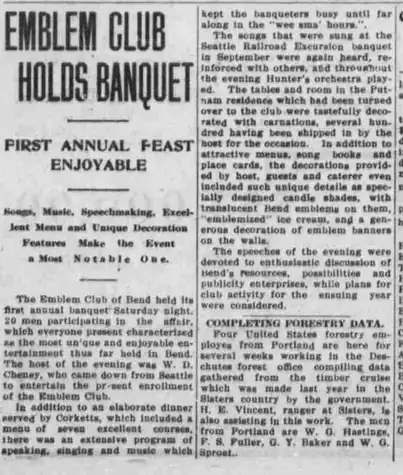
January 8, 1913
The Bulletin's report of the dinner, four days on: candle shades, emblemized ice cream, twenty men, and a club the paper already knew.
Historic Oregon Newspapers · University of Oregon Libraries
The first annual dinner, on the evening of January 4, 1913, was at the Putnam residence. G. P. Putnam was the mayor of Bend and the owner of the Bulletin, and his paper reported the evening four days later: carnations by the several hundred, Hunter’s orchestra, and decorations that went further than anyone had asked, “specially designed candle shades, with translucent Bend emblems on them, ‘emblemized’ ice cream, and a generous decoration of emblem banners on the walls.” Twenty men sat down. Six of them received certificates of membership that night.
The man who paid for all of it did not live in Bend and never would. Cheney, the paper said, “came down from Seattle to entertain the present enrollment of the Emblem Club.” He was the club’s founder and its only officer, and the title he chose for himself was a joke about money. No member was ever to mention money at a meeting. The club’s device, he said, might as well have been a dollar sign with a word beneath it:
$ TABOO
The one officer, the man who paid for everything, was the Taboo. The rest of the rules were just as strange. No initiation fee, no dues, no assessments, no elected officers, no committees. Membership was “permanently limited to forty,” and there were twenty-one. A candidate was proposed on a card and voted on by cards mailed to Cheney marked “No,” “Yes,” or “Doubtful,” with nothing else on them, and the vote had to be unanimous. A man who was rejected would never know he had been considered. A man who was accepted would learn it when the emblem was placed on his coat. Contributions were secret and stayed secret: a young man without a dollar might march between a man paying ten dollars and a man paying two hundred, “and not one of the three knows what the others have done.”
Character was the only qualification. “The poorest-paid stenographer in this city, if he has the character, and force of character, of any man at this table, is wanted in the Emblem Club; and though a man have the wealth of Croesus, if he has not a fine and forceful character, he is not wanted here.”
There was a uniform, and it was not modest: patent leather shoes, dark blue trousers, a dark blue inverness cape, white vest and white tie, a two-and-a-half-inch gold satin ribbon across the shirt front from right shoulder to left hip, a black silk hat, white kid gloves, and for parades a dark blue chapeau with the emblem at the side. “We will appear in the ‘Pathe Weekly’; and on moving-picture screens we shall march around the globe.” Nobody was to buy his own uniform except the shoes, the tie and the shirt.
The creed of this Club shall be what Stevenson considered the sum of human virtue: To be brave, to be honest, to be kind, and to be cheerful.
There was a motto too, Fide et Fiducia, “By fidelity and confidence”: fidelity to each other and confidence in Bend. And there was a proverb, “These walls are thick.” The mayor had just confided to the room some secret difficulties in his administration, and Cheney was pleased. The day would come, he said, when any member could say anything in the club with the certainty that not a word would be heard outside it. Forty such men, he went on, could make a Governor of Oregon. They could seat a President of the United States. He did not mean that they would ever try.
There was champagne, two glasses for each man. “Anybody will get drink at the Emblem Club; nobody will get drunk.” A member who preferred could turn his glass over or leave it full, “and if Mr. Putnam is sitting beside him, the wine will not be wasted.”
And there was a baton. It had been carried at “the first banquet ever given in Bend,” it lay on the table that night, and at Cheney’s death it was to pass by will, with an endowment, to a successor he would name himself, who would hold the office for life and name his own. He ended on the club’s own absurdity and turned it: “it is audacious, egotistic, Quixotic; and the joke of it is, it cannot fail. The Emblem Club may act once a month or once in five years; it may have forty members or two members; but it will never cease to exist.”
That spring the club went on the road. In May sixteen members rode to Portland as guests of the Portland Ad Club, in the same parlor car the Royal Rosarians used, and the Bulletin printed every name: Keyes, Hunter, Coe, McKay, Hudson, Gould, Rhodes, Skuse, the two Laras, Pringle, Coble, Sawhill, Jones, Steidl, Putnam. The club never kept a roll that survives. That list is the closest thing to one.
The objects of this chapter
4 of this chapter's 8 records. The strip scrolls sideways.
-
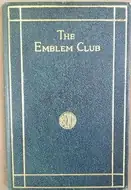
The first annual dinner, in the club's own words
January 4, 1913
The source for this whole chapter: the oath, the creed, the rules and the joke, as the founder delivered them.
-
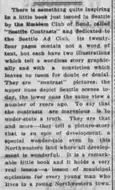
February 5, 1913
A month after the dinner the club published a book with no text in it at all — the argument made entirely in pictures.
-
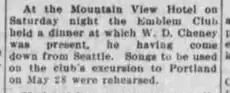
May 14, 1913
They practised. Whatever else this club was, it took its own performances seriously.
-
A march called The Emblem Club
December 24, 1913
Inside a year the club had a march named after it, playing at the picture house on Christmas week.
Sources for this chapter (8) — primary unless marked
The Emblem Club — Being a Memory of the Address of the Taboo at the First Annual Dinner of the Club — January 4, 1913 · The Bend Bulletin, 8 January 1913, page 12, columns 1-2: "Bend Emblem Club Holds Banquet" · Rehearsing for the Portland trip · Sixteen Emblem Club members named on a trip to Portland · The Bend Bulletin, 14 October 1914, page 8, columns 1-2: a Portland dinner in honour of W. D. Cheney · William D. Cheney’s obituary and the club’s remembered beginnings · “Bend Emblem Club”, Deschutes Historical Museum, 2013 (this project's reading) · The Seattle Times on the Emblem Club, November 1912, recovered from a 1962 column
Next
3. Wearing the promise
The oath, and three years of keeping it in public: a log house on the river, a governor at dinner, and the emblem set into glass.