Home / Archive / February 5, 1913
A wordless story of Seattle
The Bend Bulletin · February 5, 1913
In the story: 2. The Taboo, 1913.
Drag to pan. Scroll, pinch, or press + and − to zoom. Esc closes.
Twenty-four pages, forty-eight pictures and not one word of text — a book the Emblem Club published in Seattle and nobody has found since.
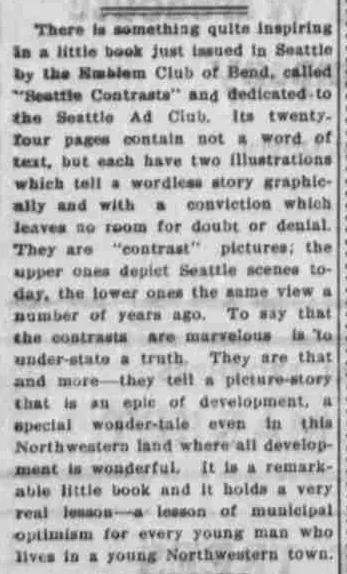
An editorial paragraph, set between rules, about a book the Emblem Club of Bend published in Seattle and dedicated to the Seattle Ad Club. Twenty-four pages, two illustrations on each, and no text at all: the top picture a Seattle street as it was now, the bottom the same view years earlier.
The argument is made entirely by the pairs, and it is an argument about Bend without Bend appearing in it. If Seattle could do that, so can a town of a thousand people on the Deschutes. The Bulletin calls it “a lesson of municipal optimism” — and municipal patriotism is one of the six qualities the Bend Park Company had promised for the emblem seven months earlier.
No copy of this book is known. What survives of it is this paragraph and one other: the Washington Historical Quarterly reviewed it in 1913, the only scholarly notice the club is known to have had, and its reviewer had the book in his hands. Between them they describe a publication nobody has seen since.
On the same page of this issue, the Bend Park Company printed the circular emblem beneath an advertisement for its property.
From the source
There is something quite inspiring in a little book just issued in Seattle by the Emblem Club of Bend, called “Seattle Contrasts” and dedicated to the Seattle Ad Club. Its twenty-four pages contain not a word of text, but each have two illustrations which tell a wordless story graphically and with a conviction which leaves no room for doubt or denial. They are “contrast” pictures; the upper ones depict Seattle scenes today, the lower ones the same view a number of years ago. To say that the contrasts are marvelous is to under-state a truth. They are that and more — they tell a picture-story that is an epic of development, a special wonder-tale even in this Northwestern land where all development is wonderful. It is a remarkable little book and it holds a very real lesson — a lesson of municipal optimism for every young man who lives in a young Northwestern town.