
Home / The Story / A city of two thousand
1. A city of two thousand
Chapter 1 of 8 to 1912
100,000 · the promise, 187 times the town, far above this chart
Bend counted 536 in 1910
- 1. A city of two thousand to 1912 · 16 records
- 2. The Taboo 1913 · 8 records
- 3. Wearing the promise 1914–1916 · 20 records
- 4. Emblematic measles 1917–1922 · 81 records
- 5. For the use of all 1923–1929 · 10 records
- 6. The emblem outlives the club 1930–2010 · 58 records
- 7. They got there 2011–2021 · 29 records
- 8. Carrying it forward since 2022 · 14 records
A Seattle land company drew a mark for a town of two thousand and printed it a page high, six months before anyone swore by it.
About 3 minutes · 16 records
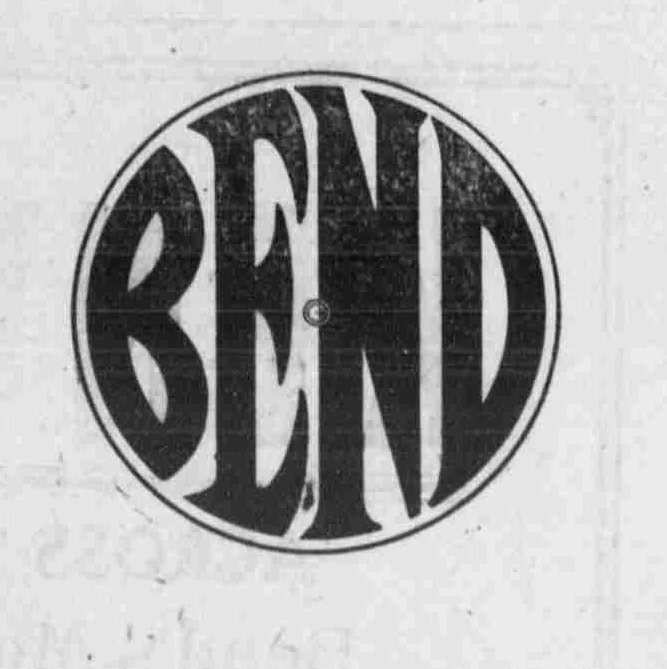
The oldest Bend Emblem this project has found
July 3, 1912
A land company's brand, printed a page high, over a notice that claims copyright and promises a lifetime.
Historic Oregon Newspapers · University of Oregon Libraries
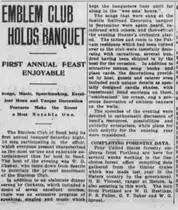
On the morning of January 4, 1913, a Seattle businessman named W. D. Cheney boarded the observation car of a transcontinental train at Portland, and the porter asked him where he was bound.
“To the metropolis of Central Oregon.”
“Oh, Bend! Change cars at Fallbridge.”
That night, at a dinner table in Bend, Cheney told the story as evidence. A year earlier, he said, no porter on a limited train could have answered the question at all. “That, gentlemen, is what builds cities.” He was talking to twenty men in a town he called two thousand, and he was explaining what they had all been doing for a year and a half.
They had been selling Bend. Cheney was president of the Bend Park Company, a Seattle land firm with lots to sell in an addition southeast of town, and its method from the start was print. In June 1911 it announced The Bend Book, fifty-eight pages and sixty-seven photographs, written by Cheney himself. No copy has been found.
In November 1911, three weeks after the first train reached Bend, the company ran a contest in the Bulletin. It offered $150 in prizes to whoever best guessed what Bend’s population would be the following July. “The population then was 1,000,” the advertisement said. “In eight months’ time what will it be?” The catch was in the rules. Every guess had to come with reasons, in not more than twenty-five words, and the prizes would go to the best reasons rather than the closest number. The company was paying people to argue that Bend would grow. No winner was ever announced.
Bend had wanted a mark of its own before any of this. In January 1908 a merchant named A. M. Lara proposed a device “about the size of a dollar” for every Commercial Club member’s letterhead, and the club offered ten dollars for the best design. No winner was ever reported, and nothing connects Lara’s idea to what came next.
On July 3, 1912, the Bend Park Company bought a page of the Bulletin and printed, in the white space at the top of it, a small black disc with the word BEND cut out of it in tall white letters. Beneath the disc, in a ruled box, the company said what it meant to do.
The above brand is copyrighted. The Bend Park company, to whom it belongs, intend to devote a life-time to making this brand a coveted guaranty of integrity, optimism, persistence, co-operation, hospitality, and municipal patriotism — in other words, and succinctly, to make it an emblem of TRUE SUCCESS.
Two weeks later the same company ran another long advertisement in the same paper and did not use the mark. Not even the firm that claimed it treated it as a house brand. It was a mark for a town, and the town took it up at once.
That same month the Bend booth at Seattle’s Potlatch festival was “decorated throughout with blue and gold, the colors of the Emblem Club,” with an electric transparency of the emblem lit inside it. Printed on July 24, 1912, that sentence is the first time the club is named anywhere. In September a special train brought Seattle visitors to Bend with the emblem, electrically lit, on its rear platform. In December the Bulletin’s press ran off ten thousand copies of a booklet called What Others Say About It, with a blank square on the back cover so that anybody could stamp a name in it and send it on.
The emblem is older than the club, and the club is older than the dinner where it sat down to explain itself. The land company that drew the mark meant to devote a lifetime to it. The men who swore by it six months later did not invent it. They adopted it, and a decade later they would give it away.
The objects of this chapter
4 of this chapter's 16 records. The strip scrolls sideways.
-
January 10, 1908
Four years early, somebody in Bend asks for a mark of the town's own — and this is the only page that names who proposed it.
-
The Bend Park Company and The Bend Book
June 21, 1911
The company that would copyright the emblem, arriving in the Bulletin a year beforehand as a publisher.
-
A silver cup for Bend's flowers
August 21, 1912
Six weeks after the emblem was printed, the club already bore its name and was giving the town prizes under it.
-
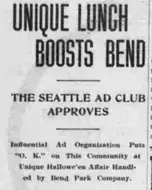
A Hallowe'en lunch for Seattle
December 4, 1912
A month before the first annual dinner, the club was already doing the thing it would later write rules for.
All 16 records from 1912 and before
Sources for this chapter (13) — primary unless marked
The Emblem Club — Being a Memory of the Address of the Taboo at the First Annual Dinner of the Club — January 4, 1913 · The Bend Park Company and The Bend Book · $150 Cash Prizes: What Will Be the Population of Bend, Oregon, July 1, 1912? · Guess Bend's Gain: prizes totalling $150 offered by real estate company · A. M. Lara proposes a trade mark for the Bend Commercial Club, January 1908 · A $10 prize for a Bend medallion · The Bend Bulletin, 3 July 1912, printed page 8 (image sequence 28): full-page advertisement carrying the emblem · The Bend Park Company advertises, without the emblem · The Bend Bulletin, 24 July 1912, page 12, column 1: the Bend booth at the Seattle Potlatch · The Bend Bulletin, 4 September 1912, page 1: the Seattle excursion train · The Bend Bulletin, 4 December 1912, page 8, column 2: the What Others Say About It booklet · “Bend Emblem Club”, Deschutes Historical Museum, 2013 (this project's reading) · William D. Cheney’s obituary and the club’s remembered beginnings
Next
2. The Taboo
Twenty men, two glasses of champagne each, and the strangest set of club rules in Oregon.