Home / Archive / July 24, 1912
Blue and gold at Seattle’s Potlatch
The Bend Bulletin · July 24, 1912
In the story: 1. A city of two thousand, to 1912.
Drag to pan. Scroll, pinch, or press + and − to zoom. Esc closes.
Three weeks after the copyright notice, the emblem was in Seattle as a lit transparency filling the back of a booth, under 275 lights in blue and gold.
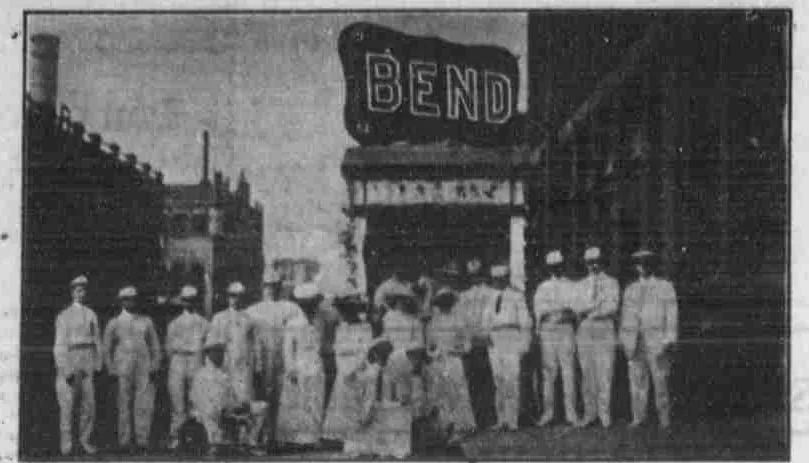
Seattle’s Potlatch was the Northwest’s summer carnival, and in July 1912 the Bend Park Company took a booth at it. The Bulletin printed a photograph of the booth and the sales force — a dozen men and women in summer whites under a sign spelling BEND in outlined capitals — and a dispatch describing what the photograph cannot show.
Two things in it matter. The first is the date. This is three weeks after the company bought a whole page of the Bulletin to say the emblem was its and was copyrighted, and here the emblem is in another state, on the largest scale anything in this archive records: “the entire back of the booth inside was an electric transparency of the blue and gold emblem of the Emblem Club”, with 275 incandescent lights outside it in the same two colours.
The second is that the club is named, in July 1912, as a body with its own colours and its own emblem — six months before the founding dinner of January 1913 that the club itself later dated from. A club that has colours and a lit emblem in Seattle is not a club that began at a dinner the following winter.
The rest is what a land company did with a carnival. A six-foot water-colour of Bend and the mountains from the top of Pilot Butte across the whole back of the booth outside; fresh flowers, grains and grasses; and over seventy thousand pieces of literature handed out, “most of them accompanied by a personal talk with the recipient” by workers dressed in white and gold, Seattle’s own colours rather than Bend’s.
One more thing this page settles, and one it does not. The club’s colours were blue and gold — the booth was decorated throughout in them and the emblem itself was shown in them. Two drawings in this archive are still in blue and gold: the roundel Visit Bend carried in 2002 and the broad-lettered one on Downtown Bend’s history page. Nothing here connects a 2002 web header to a 1912 booth, and the pair is recorded as a coincidence unless somebody finds the link.
No photograph of the transparency survives here, and the booth sign in the picture is the word BEND in plain outlined capitals rather than the roundel. What the emblem looked like in blue and gold, lit, is a description and not a drawing.
From the source
BEND MAKES GOOD SHOWING AT THE POTLATCH
Bend Park Company’s Booth at Seattle Last Week and Part of Sales Force.
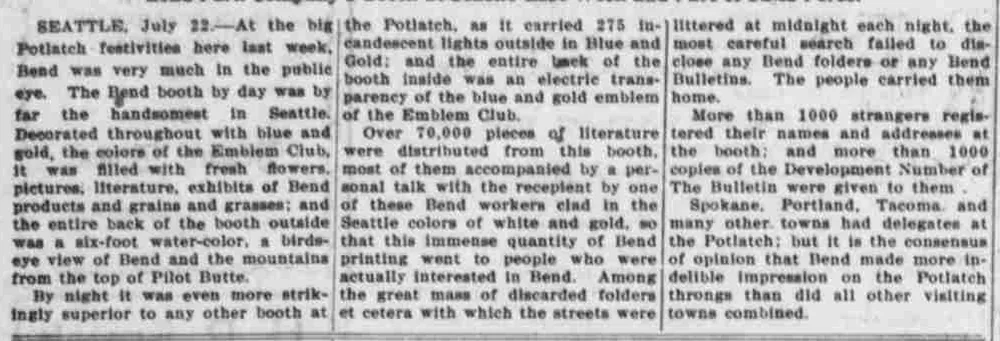
SEATTLE, July 22. — At the big Potlatch festivities here last week Bend was very much in the public eye. The Bend booth by day was by far the handsomest in Seattle. Decorated throughout with blue and gold, the colors of the Emblem Club, it was filled with fresh flowers, pictures, literature, exhibits of Bend products and grains and grasses; and the entire back of the booth outside was a six-foot water-color, a birds-eye view of Bend and the mountains from the top of Pilot Butte.
By night it was even more strikingly superior to any other booth at the Potlatch, as it carried 275 incandescent lights outside in Blue and Gold; and the entire back of the booth inside was an electric transparency of the blue and gold emblem of the Emblem Club.
Over 70,000 pieces of literature were distributed from this booth, most of them accompanied by a personal talk with the recipient by one of these Bend workers clad in the Seattle colors of white and gold …