The emblem in O’Kane’s glass
Another Believer, Wikimedia Commons · 2012
In the story: 7. They got there, 2011–2021.

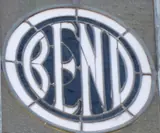
A circular Bend emblem fills a pane in this photograph of an O’Kane Building transom.
Photographed by Another Believer in 2012, the window makes the emblem part of the street. The building contains both original and replacement glass; this photograph alone does not establish which kind of pane it shows.
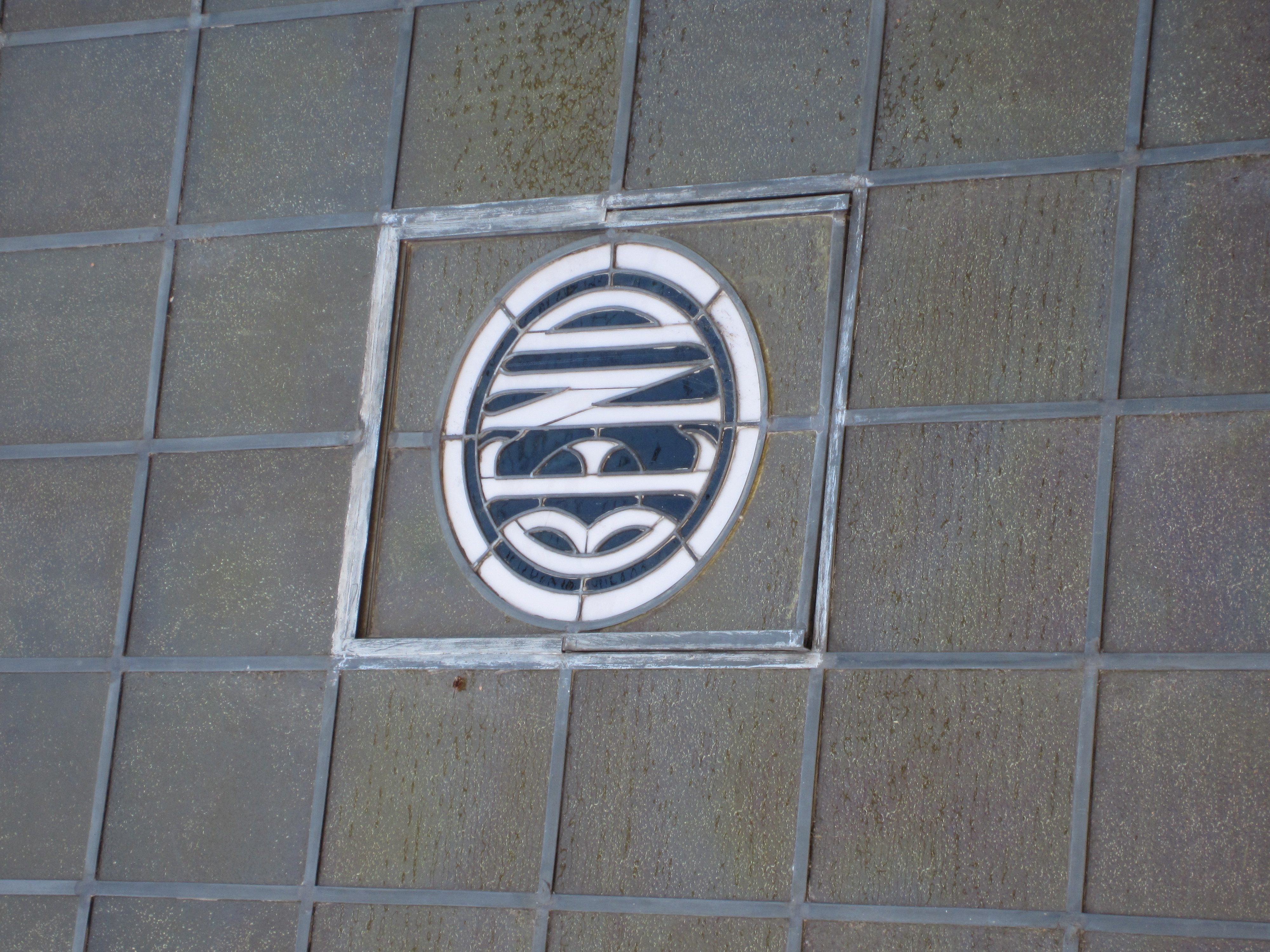
A second photograph from the same session, uploaded under an almost identical name, gives the pane three times the area. It was found on 14 September 2026 and left as research evidence because the memo that found it recorded the image as “rotated a quarter turn”. It is not. The file carries an EXIF orientation tag — value 6, which asks a viewer to turn it — and anything that reads the stored pixels without that tag sees the pane on its side. On its side, BEND appears to read bottom to top. That is what a 2026 research deliverable saw, and it built a claim on it: that the 1916 transom spells the word vertically while every later mark reads across, so orientation is a branch in the emblem's design record. Turn the file the way its own tag asks and the pane reads across, like everything else. The branch is a metadata tag.
The deliverable also reports “small illegible text” following the bottom inner curve. Enlarged from the upright copy, there is none: what follows the curve is the lead came holding the glass.
The panes were still in the transoms on 12 October 2023, when somebody photographed the whole building from the far pavement and put it on Wikimedia Commons. At that distance each pane is about twenty-five pixels and no letter in one can be read; what the photograph establishes is that they are there, which is worth a line because the building has been reglazed at least once.
Measured
The O’Kane glass, the angular construction. The angular construction worked in glass: narrow came letters standing clear of a double ring, with the B's bowls meeting in a straight join.
Read at medium confidence from 355 px of letter, which is the letters alone, at this drawing's own letter cut.
Each drawing is reduced to the same thing — the letters BEND, cropped to their own ink, rasterised at a common size — so two of them can be compared by shape alone.
- Device aspect
- 1.006 The roundel’s width divided by its height. 1.000 is a true circle; anything else is an oval, or a photograph taken at an angle. 0.977 – 1.048 across the collection
- Word aspect
- 1.442 The same ratio for the block of BEND letters alone, once cropped to their own ink. 0.927 – 1.862; the high end is lettering set wide rather than stacked
- Figure ink
- 0.416 How much of the drawing is ink rather than ground. A heavy ring and fat letters push it up. 0.169 – 0.728, median 0.493
- Coverage
- 0.416 How much of the normalised square the letters fill once every drawing is reduced to the same size. 0.198 – 0.576, median 0.456
What it most resembles. Two digitisations of a single printing score 0.975, so that is what “the same artwork” looks like as a number.
- Vintage Bend profile rendering 0.379 — different drawings
- Modernisation reference made with ChatGPT, 2026 0.374 — different drawings
- Bend Chamber of Commerce, June 1953 0.368 — different drawings
Least like it: Bend Rubber Stamp & Printing, at 0.149.
Resemblance is not descent. A high score means two drawings have the same shape. It does not establish which came first, or that either was copied from the other.
Ties touching this drawing, each in the class of evidence it has:
- A question Drawn from the glass?. The glass is the only emblem continuously in public view between 1953 and 2001, on the corner of Bond and Oregon, and it is narrow-lettered like the bureau’s roundel. Anyone redrawing the emblem around 2000 without a 1912 newspaper had the window and little else. What would settle it: A square-on photograph of every O’Kane transom, entered into the measurement and read at the letters cut against the 2001 roundel, plus the 1985 fabrication record from Bend Stained Glass’s successor saying which panes are 1916 glass.
Compare this drawing with another · The board · How the drawings were measured
Seen in use
2 dated sightings, 2012–2023. Each is a record of this object or this drawing somewhere else, and where a picture is hosted it is a documentary crop of the object, credited to whoever holds it.
-
 July 6, 2012 Another Believer, Wikimedia Commons · The O’Kane transom pane, photographed a second time the same day at three times the area Photograph, CC BY-SA 3.0 · commons.wikimedia.org The file is stored on its side with an EXIF orientation tag asking a viewer to turn it. Read without the tag the pane appears to spell BEND bottom to top, which is what a 2026 research deliverable built a design-history claim on. Another Believer, Wikimedia Commons, CC BY-SA 3.0; documentary reproduction at documentary size for commentary. Licence: https://creativecommons.org/licenses/by-sa/3.0/. Source: https://commons.wikimedia.org/wiki/File:O%27Kane_Building_detail,_Bend,_Oregon,_2012.JPG
 - October 12, 2023 UpdateNerd, Wikimedia Commons · The O’Kane shopfront transom band, with at least two emblem panes in place Photograph, CC BY-SA 4.0 · commons.wikimedia.org Each pane is about 25 px across from the far pavement: the panes are identifiable by shape, ring and position, and no letter in them is legible. It is the latest dated sighting of the glass this archive holds, eleven years after the 2012 photographs.