
Painted, in an alley
Tin Pan Alley art collection, Bend · Undated
This record carries no date and is not plotted along the story. The archive holds it.
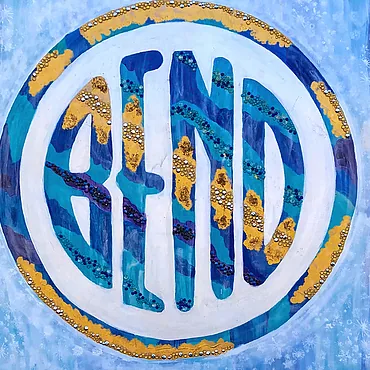
Somebody painted the emblem three feet across in blues and golds and hung it in a downtown alley, and nobody has recorded who.
Tin Pan Alley runs between Bond and Wall in downtown Bend and has carried a rotating public-art collection since 2012 or 2013. One of its panels is the emblem: the word filling a disc, the letters brushed in blues and teals with gold and beaded accents, inside a white ring and a beaded teal outer one, on a ground of pale blue with painted snowflakes.
It is the first painted mural of the emblem this archive holds, and the only object in the whole collection where the mark has been treated as something to interpret rather than reproduce. The matrix reads the letters as the museum rounding's construction — rounded corners, a last letter that runs down at one thickness — filled with weather.
The artist is not identified. The photograph is credited to Jerry Fornarotto, who is a photographer; nothing found says he painted it. Nor is the photograph published anywhere this archive can point at: it arrived in a research export under his name. What places the panel in the alley is a separate Instagram post, and that post was read from a description of its picture rather than looked at — the copy of it this archive holds is a different panel of the same collection, a lake and bare trees, with no emblem on it. So the painting is real and read at full size, and where it hangs rests on somebody else's reading. That is an open question with a short path to an answer: somebody in Bend can walk down the alley and read the label.
Where it sits, and who put it there. The panel is filed with the Downtown file, placed there by the curator on 16 September 2026 on its notched E and B detail and its capital N. The character matrix reads it in the museum rounding, and on two characters rather than one: at 262 pixels these letters are broad and run to a double ring where the Downtown file's are narrow and stand clear of theirs, and this E has three arms where that family's is notched. The notch in the B and the capital N are both really there and neither separates these two families. Both readings are the record.
Measured
The Downtown file, the notched construction. The same narrow letters and notched E as the bureau roundel, with a capital N.
Read at high confidence from 262 px of letter, which is the letters alone, at this drawing's own letter cut.
Each drawing is reduced to the same thing — the letters BEND, cropped to their own ink, rasterised at a common size — so two of them can be compared by shape alone.
- Device aspect
- 1.000 The roundel’s width divided by its height. 1.000 is a true circle; anything else is an oval, or a photograph taken at an angle. 0.977 – 1.048 across the collection
- Word aspect
- 1.003 The same ratio for the block of BEND letters alone, once cropped to their own ink. 0.927 – 1.862; the high end is lettering set wide rather than stacked
- Figure ink
- 0.436 How much of the drawing is ink rather than ground. A heavy ring and fat letters push it up. 0.169 – 0.728, median 0.493
- Coverage
- 0.343 How much of the normalised square the letters fill once every drawing is reduced to the same size. 0.198 – 0.576, median 0.456
What it most resembles. Two digitisations of a single printing score 0.975, so that is what “the same artwork” looks like as a number.
- City of Bend Neighborhoods, 2023 0.585 — related letterforms, clearly redrawn
- Vintage Bend profile rendering 0.537 — related letterforms, clearly redrawn
- The Bend Store sticker 0.536 — related letterforms, clearly redrawn
Least like it: Bend Rubber Stamp & Printing, at 0.205.
Resemblance is not descent. A high score means two drawings have the same shape. It does not establish which came first, or that either was copied from the other.
Compare this drawing with another · The board · How the drawings were measured