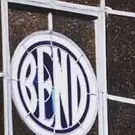
Home / Archive / February 4, 2016
On an office wall, 2016
Fred Real Estate Group · February 4, 2016
In the story: 7. They got there, 2011–2021.
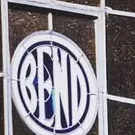
A real-estate firm hung the emblem over its sofa, and in doing so left the earliest business sighting the social record holds.
The picture is an ordinary one: a green sofa, striped cushions, a potted plant, and above it a panel of dark tile in a white grid, with a large BEND disc in the middle of it. The firm posted it on 4 February 2016 and the same disc appears in frames of an office-tour video that December.
It matters because of where it sits in the sequence. The civic accounts start in 2013 and the shop that carries the emblem hardest starts in 2017; this is the earliest sighting by an ordinary Bend business that anybody has found. The mark had left the City and the bureau and gone onto somebody's wall.
The drawing reads, character by character, as the Downtown file's: light narrow letters filling a dark disc, a notched B, a notched E level with it, an ordinary capital N, an even last letter, all inside a light ring the letters stop short of. It is filed with the O'Kane glass all the same, and the paragraph below says who put it there and why.
Where it sits, and who put it there. The disc is filed with the O'Kane glass, placed there by the curator on 16 September 2026 because it is stained glass: a leaded panel in the transom's own blue and white, with the came lines crossing it in this photograph. That is a grouping on medium and on descent, which is the one kind the families handbook allows to be made on something other than a character — and the second time it has been made. The character matrix disagrees: at 91 pixels of letter this B's two bowls meet in a notch where the transom's meet in a straight join, and that join is the one character that isolates the O'Kane glass from every other narrow drawing on file. By the matrix this is the Downtown file. What would settle it is a photograph of the panel close enough to read the join.
Measured
The O’Kane glass, the angular construction. The angular construction worked in glass: narrow came letters standing clear of a double ring, with the B's bowls meeting in a straight join.
Read at medium confidence from 91 px of letter, which is an upper bound: this drawing's letters run into its ring, and no cut separates them.
Each drawing is reduced to the same thing — the letters BEND, cropped to their own ink, rasterised at a common size — so two of them can be compared by shape alone.
- Device aspect
- 0.979 The roundel’s width divided by its height. 1.000 is a true circle; anything else is an oval, or a photograph taken at an angle. 0.977 – 1.048 across the collection
- Word aspect
- 0.877 The same ratio for the block of BEND letters alone, once cropped to their own ink. 0.927 – 1.862; the high end is lettering set wide rather than stacked
- Figure ink
- 0.337 How much of the drawing is ink rather than ground. A heavy ring and fat letters push it up. 0.169 – 0.728, median 0.493
- Coverage
- 0.302 How much of the normalised square the letters fill once every drawing is reduced to the same size. 0.198 – 0.576, median 0.456
What it most resembles. Two digitisations of a single printing score 0.975, so that is what “the same artwork” looks like as a number.
- The council chambers disc 0.331 — different drawings
- Deschutes Historical Museum, 2012 0.330 — different drawings
- Downtown Bend gold roundel 0.325 — different drawings
Least like it: Bend Contracting, 2021, at 0.179.
Resemblance is not descent. A high score means two drawings have the same shape. It does not establish which came first, or that either was copied from the other.
Compare this drawing with another · The board · How the drawings were measured
Seen in use
2 dated sightings, 2016. Each is a record of this object or this drawing somewhere else, and where a picture is hosted it is a documentary crop of the object, credited to whoever holds it.
-
 February 4, 2016 Fred Real Estate Group · Circular BEND panel on the dark tiled wall of the firm’s office Photograph of the object · instagram.com Fred Real Estate Group; documentary reproduction at documentary size for commentary, with attribution and a link. Source: https://www.instagram.com/p/BBYHnBfQ2ma/
 -
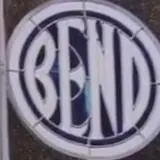
 December 6, 2016 Fred Real Estate Group · The same office wall panel, in frames of an office-tour video Frame from a video · instagram.com Fred Real Estate Group; documentary reproduction at documentary size for commentary, with attribution and a link. Source: https://www.instagram.com/p/BNryqkPgQEI/