
Merely for convenience
The Bend Bulletin · June 5, 1920
In the story: 4. Emblematic measles, 1917–1922.
Drag to pan. Scroll, pinch, or press + and − to zoom. Esc closes.
The page that answers the question, and not in the direction this archive had been leaning.
This project has carried an open question — when did women join the Emblem Club, and as what? The 1913 book describes forty men and a cap on the membership. From 1920 the Bulletin writes of “the lady-members of the Emblem club” against “the men members”, of “the Ladies of the Emblem Club”, and of “the wives of Emblem club members”, in that order, within nine months. Two days ago this archive read the March notice as its best evidence that women were members in their own right.
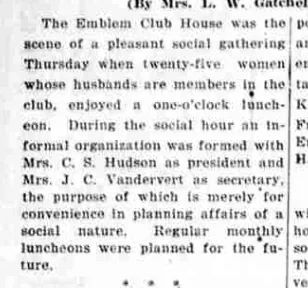
This page is better evidence and it points the other way. The women here are defined by their husbands' membership. What they formed on June 3, 1920 was not a section of the club but a separate informal body with its own president and its own secretary, and the paper is unusually explicit about how little it claimed to be: merely for convenience in planning affairs of a social nature.
Two months later the Bulletin would name it — “the ladies' auxiliary of the club” — and from there the record runs steadily: regular semi-monthly meetings, then regular monthly luncheons of twenty-one and twenty-two, a regular business luncheon, a regular social meeting, officers elected in October 1920. The “lady-members” of the newspaper's shorthand are the members of this body.
It does not dispose of everything. In August 1921 the paper calls Mrs. T. A. McCann “a charter member of the reorganized Emblem club”, which is not language for an auxiliary, and the club's own records have never been found. But the plainest document available says an informal organization was formed in June 1920 by women whose husbands were the members, and that is now what this archive says.
From the source
The Emblem Club House was the scene of a pleasant social gathering Thursday when twenty-five women whose husbands are members in the club, enjoyed a one-o'clock luncheon. During the social hour an informal organization was formed with Mrs. C. S. Hudson as president and Mrs. J. C. Vandervert as secretary, the purpose of which is merely for convenience in planning affairs of a social nature. Regular monthly luncheons were planned for the future.