
Home / Archive / October 19, 1918
The Answer
The Bend Bulletin · October 19, 1918
In the story: 4. Emblematic measles, 1917–1922.
Drag to pan. Scroll, pinch, or press + and − to zoom. Esc closes.
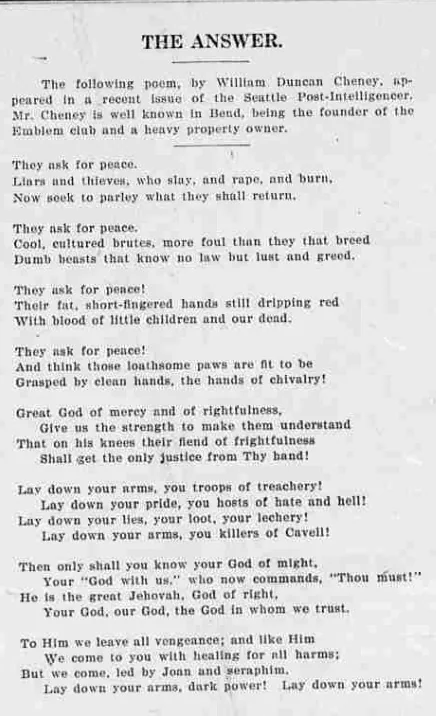
The club's founder, in print in a Seattle daily, six years after he wrote the club its oath.
The poem is a reply to the German peace notes of October 1918, and it is written at the top of its voice. “They ask for peace. / Liars and thieves, who slay, and rape, and burn, / Now seek to parley what they shall return.” Four such stanzas, then a prayer, then four lines beginning “Lay down your arms” — one of them “Lay down your arms, you killers of Cavell!”, for the British nurse shot in Brussels in 1915 — and a close that borrows Joan of Arc. It is period atrocity rhetoric, published three weeks before the Armistice, and it is reproduced here as a historical document rather than for its argument.
What the archive gains is Cheney as a writer in public. He wrote the Emblem Club's address at its first annual dinner, which the 1913 book preserves, and the club's oath and creed are his. Outside that book this project has held almost nothing of his own words. Here he is in a metropolitan daily, reprinted at home, and the paper introduces him to Bend readers by the club he founded rather than by his business — six years after founding it, and with him long since living in Seattle.
It also puts verse in his hands, which is worth holding beside the Emblem Club's song repertoire. The archive has four lines of one club song, recovered from a 1921 editorial. Nothing connects Cheney to that verse, and this page does not, but a founder who wrote publishable poetry is a different kind of candidate for having written the club's songs than one who did not.
From the source
THE ANSWER. The following poem, by William Duncan Cheney, appeared in a recent issue of the Seattle Post-Intelligencer. Mr. Cheney is well known in Bend, being the founder of the Emblem club and a heavy property owner.